Penetration Testing and Ethical Hacking in WANs (HCK2)
Cybersecurity, ICT Security
This practical course presents a structured method for penetration testing of WAN infrastructures, stressing realistic attack scenarios and intensive hands-on labs. Participants learn to map remote networks, identify and validate vulnerabilities, and plan safe tests on Windows and Linux.
The course trains use of security distributions like Kali Linux and professional Metasploit workflows for exploitation and privilege escalation. You will practice IDS/firewall evasion, VPN and DoS testing, shellcode handling and post forensic analysis.
THIS TRAINING COURSE WILL HELP YOU:
- Learn WAN reconnaissance and target identification techniques.
- Use Kali Linux for practical testing and security tools.
- Identify vulnerabilities with scanners and public CVE data.
- Apply Metasploit for exploitation and privilege escalation.
- Perform IDS/firewall evasion, VPN and DoS testing, and forensics.
WHO SHOULD ATTEND?
- Network and system administrators (Windows and Linux)
- Penetration testers and security consultants
- DevOps engineers and WAN administrators
- Security analysts and SOC team members
- Developers responsible for securing network applications
COURSE LOCATION AND AVAILABLE DATES
11–13 Jan 2027
756 €
CZECH
19–21 Apr 2027
756 €
CZECH
Praha + online (optional)
11–13 Jan 2027
756 €
CZECH
26–28 Jul 2027
756 €
CZECH
Need this course in English?
Public courses are usually delivered in Czech, but this course is also available in English. We can arrange private training for your team online, at your premises or in our classrooms, and tailor the content to your needs.
For groups of around 4 or more participants, private training can already be comparable in price to booking individual places on a public course. Send us your requirements and we’ll recommend the best format and provide an exact quote.
Request training in English
Course content:
Hide details
-
Reconnaissance of targets on the Internet
-
Discovering the target's online presence
-
Determining the target's IP ranges
-
Offensive tools for Linux and Windows
-
Basics of inventory and using network-layer scanners
-
Overview of different scanner types
-
Using scanners for higher-layer reconnaissance – amap, dsniff
-
Tracing the route to a target and scouting firewalls using firewallking
-
Detection techniques
-
Standard and specialized scanners
-
Using them to scan services
-
Inventory options via higher-layer protocols (LDAP, SNMP, etc.)
-
Discovering vulnerabilities of WAN targets
-
Using independent vulnerability and weakness databases
-
Using discovered vulnerabilities to gain and escalate privileges on remote systems
-
Using Metasploit in a WAN context
-
Modifying shellcode to bypass intrusion detection
-
Privilege escalation options and demonstrating remote system control
-
Automating penetration tests with Metasploit
-
Basics of writing shellcode, types and establishing connections to targets
-
Demonstration of shellcode usage
-
Kernel and memory manipulation by malicious code and rootkits
-
Practical removal of shellcode from an OS
-
Description of attacks at the network layer
-
Attack forms against protocols and services such as DNS, HTTP and others
-
Direct attack possibilities on network devices, primarily Cisco IOS
-
Use of stack-overflow techniques
-
Demonstrations of DoS attacks on various protocols and services
-
Ensuring response to unusual network activity
-
Examples of monitoring and detection tools
-
Bypassing firewalls, IDS and honeypots
-
Logging options for standard and non-standard activity
-
Demonstrations of attacks on web and proxy servers
-
Security review of MS IIS web server
-
Exploiting servers via dynamic code – ActiveX
-
Implementation flaws in the Java Virtual Machine
-
Browser weaknesses
-
Reconnaissance of VPN services on remote systems and potential VPN attacks
-
Defenses using encryption – SSL, IPSec and other techniques
-
Actions after confirming a system compromise
-
Tracing attacker activity
-
Hiding traces of illegal activity
-
Capabilities of standard security audit tools
-
Prerequisites:
-
Experience with Windows and Linux; basic understanding of TCP/IP network security.
-
Recommended previous course:
-
Penetration Testing and Ethical Hacking (HCK1)
-
Schedule:
-
3 days (9:00-17:00)
-
Price per person:
-
756.00 € ( 914.76 € incl. 21% VAT)
Training and learning environment
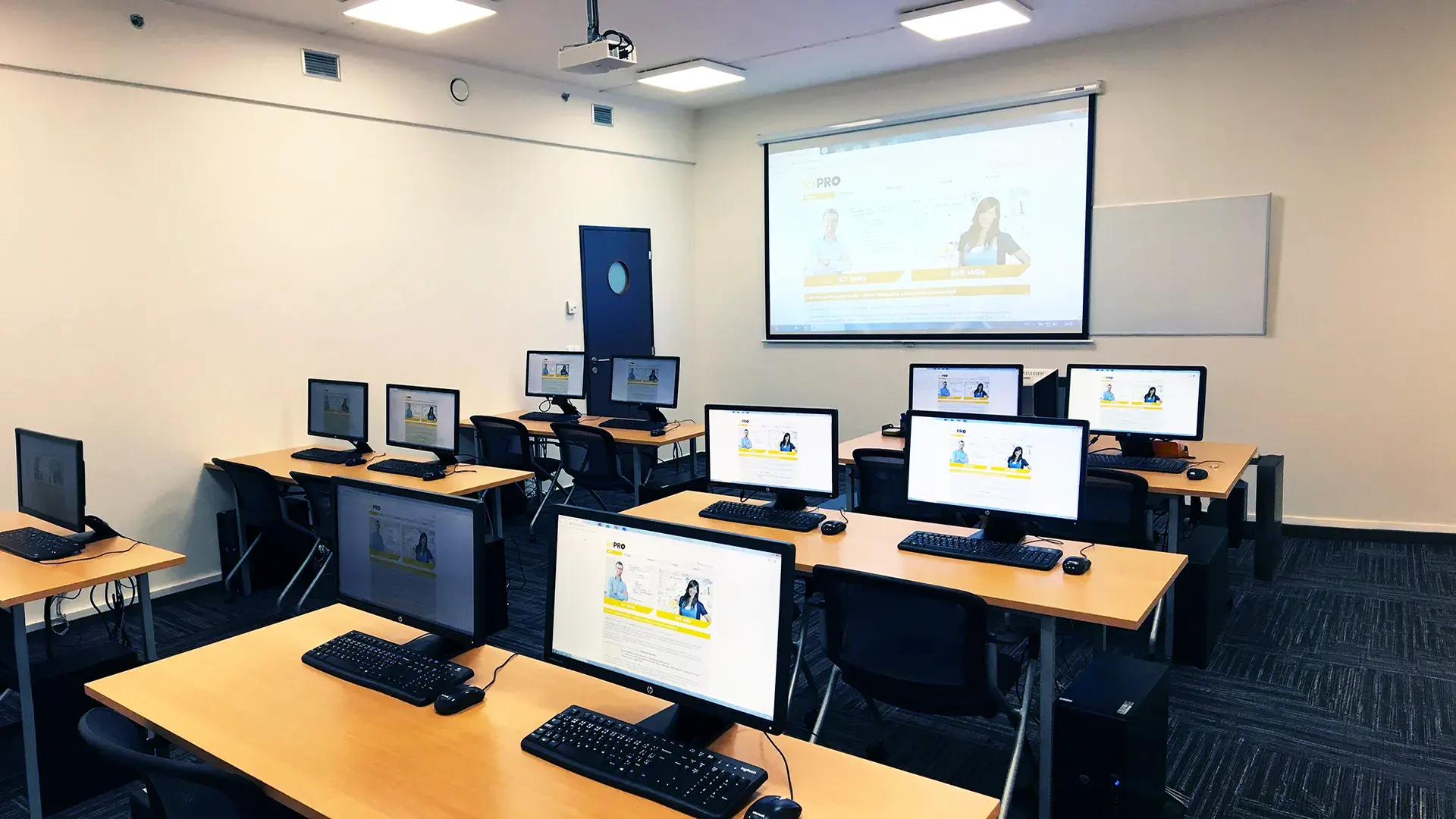 What does the environment for in-person IT courses look like?We hold training courses in our own classrooms equipped with modern computer equipment for each participant and a large projection screen. Each workstation is fitted with a powerful computer for seamless practical exercises, and the environment supports a calm, friendly atmosphere during training.
 Do I need to bring my own laptop to the classroom IT course?Our training rooms are fully equipped, so you do not need to bring your own laptop. A modern computer with all necessary hardware and software is ready for you at your workstation.
 Will you receive an official certificate after completing an IT course?Yes, upon successful completion of the training course, you will receive an official ICT Pro certificate confirming your participation and acquired technical skills. You can use it to verify your qualifications or add it to your professional profile.
 Where can you find our training center in Brno?The premises of the ICT Pro training center are located on the 1st floor of the COMGUARD building at Sochorova 38 in Brno. Positioned on the border of Žabovřesky and Komín, the location is easily accessible by both car and public transport.
 Where can you find our training center in Prague?The premises of the ICT Pro training center are located on the 1st floor of the Opatov Park building at Líbalova 1, Prague 11 – Chodov. The location provides a comfortable environment for your education with convenient access.
 What facilities and refreshments are available to you during training breaks?Our training centers feature a fully equipped kitchenette for a comfortable break during your courses. The facilities include a coffee machine, microwave, kettle, and a wide selection of drinks and snacks.
 What beverage refreshments are available during your course?A beverage station with a coffee machine, teas, syrups, and water is at your disposal throughout the entire training session. You can enjoy a coffee or another drink of your choice anytime during breaks.
 What light refreshments are provided for you during the courses?During course breaks, participants can enjoy light sweet snacks, pastries, and fruit syrups to mix their own drinks. Fresh water dispenser and plates are also available for your convenience.
 Should I bring my own snacks to ICT Pro training?There is no need to. A wide selection of savory snacks, sweet biscuits, and snack bars is available for you during breaks. Boost your energy for all-day focus right inside the training center premises.
 Can you spend training breaks in the fresh air?Yes, an outdoor terrace is available at our training center. During breaks between learning sessions, you can relax in the fresh air in a pleasant green environment.
 Where can you relax during course breaks?Our training center features a spacious outdoor terrace with seating options. During breaks between learning sessions, you can step outside to relax and recharge in the fresh air.