Hacking in Practice (HCKP1)
Cybersecurity, ICT Security
Explore practical techniques of offensive security, focusing on social engineering, malicious USB devices and automated payloads, credential theft through keyloggers and phishing, and live demos of voice and SMS spoofing used to trick users into revealing access.
Hands-on exploration of Windows and Active Directory attacks: password extraction, lateral movement, privilege escalation and defense. We also cover WiFi security from WEP to WPA3, mobile-based tools and practical mitigation techniques for real networks.
THIS TRAINING COURSE WILL HELP YOU:
- Perform social-engineering attacks and evaluate user risk
- Extract and analyze Windows credentials and AD weaknesses
- Conduct WiFi attacks from WEP to WPA3 and test defenses
- Use mobile tools for wireless assessment and on-the-go testing
- Implement practical mitigations and response techniques
WHO SHOULD ATTEND?
- IT security professionals and system administrators
- Penetration testers and ethical hackers
- Network engineers responsible for WiFi and AD security
- Anyone wanting hands-on offensive security skills
COURSE LOCATION AND AVAILABLE DATES
This public course is delivered online only, so you can attend remotely without travelling to a classroom. The same course can also be delivered in person as private training at your premises.
For technically demanding courses, prepared remote labs are provided, so you do not need to install anything locally.
Need this course in English?
Public courses are usually delivered in Czech, but this course is also available in English. We can arrange private training for your team online, at your premises or in our classrooms, and tailor the content to your needs.
For groups of around 4 or more participants, private training can already be comparable in price to booking individual places on a public course. Send us your requirements and we’ll recommend the best format and provide an exact quote.
Request training in English
Course content:
Hide details
-
Social engineering
-
Social engineering via USB flash drives
-
USB Rubber Ducky - demonstration of real attacks
-
BadUSB, USB Ninja, USB Killer – offensive USB devices
-
Techniques to trigger malware execution
-
Macro viruses and their modern use
-
DDE (Dynamic Data Execution)
-
Exploitation of MS Office vulnerabilities
-
Spoofed shortcuts and self-extracting archives
-
Demo of creating a Trojan horse
-
VirusTotal and alternative services
-
Phishing and spearphishing
-
Vishing — spoofed calls and SMS from arbitrary numbers
-
Telephone social engineering — practical insights and audio samples
-
Hardware keyloggers and videologgers — easy route to passwords
-
LAN Turtle and Bash Bunny devices
-
Defensive measures
-
Windows security
-
Passwords in Windows
-
LM/NTLM hashes — cracking and Pass-the-Hash
-
Hashcat — usage, demos and password analysis
-
LSA secrets — password extraction
-
Cached Credentials — extraction of domain user hashes
-
LSASS — extraction of plaintext credentials
-
Mimikatz and WCE tools
-
Active Directory and Windows domain security
-
LLMNR, NBNS and mDNS poisoning
-
SMB relay attacks
-
Kerberos from a security perspective
-
Kerberoasting
-
Silver and Golden Ticket attacks
-
Methods for compromising domain administrators
-
Pentest practice demonstrations
-
Defensive strategies
-
WiFi security
-
Classification of wireless technologies
-
Hacking WiFi with shared passwords
-
WEP — packet injection
-
WEP — Korek / ChopChop attack
-
WEP — fragmentation attack
-
WEP — Cafe Latte attack
-
WPA — Beck-Tews attack
-
WPA/WPA2 — handshake capture
-
WPA/WPA2 — KRACK
-
WPA3 — Dragonfly handshake vulnerabilities
-
WiFi Protected Setup (WPS)
-
Comparison of WiFi tools
-
Rogue APs and their detection
-
Hacking guest networks with captive portals
-
Hacking enterprise WiFi — PEAP (domain account)
-
Hacking enterprise WiFi — EAP-TLS (certificates)
-
Hacking enterprise WiFi — LEAP (Cisco)
-
Nethunter (Kali Linux for mobile phones)
-
Denial-of-service attacks on WiFi
-
Hacking routers and access points
-
WiFi Pineapple
-
WiFi vulnerabilities observed in the Czech environment
-
Prerequisites:
-
Familiarity with Windows and Linux and a basic understanding of TCP/IP network security.
-
Recommended previous course:
-
Basics of the TCP/IP Protocol (TCP1)
-
Recommended follow-up course:
-
Practical Hacking II (HCKP2)
-
Schedule:
-
3 days (9:00-17:00)
-
Price per person:
-
799.60 € ( 967.52 € incl. 21% VAT)
Training and learning environment
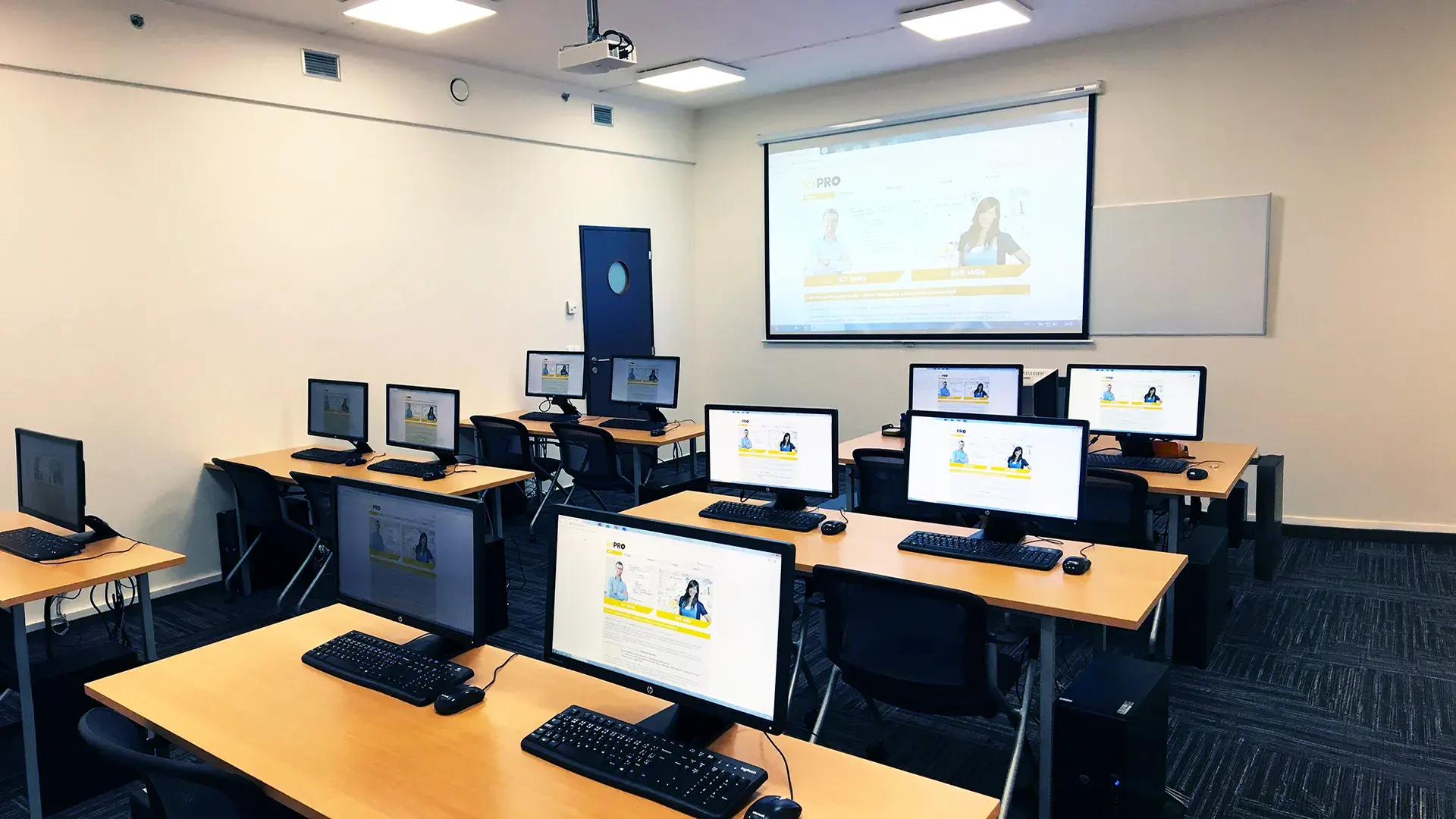 What does the environment for in-person IT courses look like?We hold training courses in our own classrooms equipped with modern computer equipment for each participant and a large projection screen. Each workstation is fitted with a powerful computer for seamless practical exercises, and the environment supports a calm, friendly atmosphere during training.
 Do I need to bring my own laptop to the classroom IT course?Our training rooms are fully equipped, so you do not need to bring your own laptop. A modern computer with all necessary hardware and software is ready for you at your workstation.
 Will you receive an official certificate after completing an IT course?Yes, upon successful completion of the training course, you will receive an official ICT Pro certificate confirming your participation and acquired technical skills. You can use it to verify your qualifications or add it to your professional profile.
 Where can you find our training center in Brno?The premises of the ICT Pro training center are located on the 1st floor of the COMGUARD building at Sochorova 38 in Brno. Positioned on the border of Žabovřesky and Komín, the location is easily accessible by both car and public transport.
 Where can you find our training center in Prague?The premises of the ICT Pro training center are located on the 1st floor of the Opatov Park building at Líbalova 1, Prague 11 – Chodov. The location provides a comfortable environment for your education with convenient access.
 What facilities and refreshments are available to you during training breaks?Our training centers feature a fully equipped kitchenette for a comfortable break during your courses. The facilities include a coffee machine, microwave, kettle, and a wide selection of drinks and snacks.
 What beverage refreshments are available during your course?A beverage station with a coffee machine, teas, syrups, and water is at your disposal throughout the entire training session. You can enjoy a coffee or another drink of your choice anytime during breaks.
 What light refreshments are provided for you during the courses?During course breaks, participants can enjoy light sweet snacks, pastries, and fruit syrups to mix their own drinks. Fresh water dispenser and plates are also available for your convenience.
 Should I bring my own snacks to ICT Pro training?There is no need to. A wide selection of savory snacks, sweet biscuits, and snack bars is available for you during breaks. Boost your energy for all-day focus right inside the training center premises.
 Can you spend training breaks in the fresh air?Yes, an outdoor terrace is available at our training center. During breaks between learning sessions, you can relax in the fresh air in a pleasant green environment.
 Where can you relax during course breaks?Our training center features a spacious outdoor terrace with seating options. During breaks between learning sessions, you can step outside to relax and recharge in the fresh air.