PHP – Introduction to Programming (PHP1)
Programming, Web Programming
This practical, hands-on course teaches PHP from the ground up for people who want to build dynamic web pages, learn essential programming principles, and see how modern web applications work. You will practice PHP syntax with real examples.
The course covers core topics such as variables, conditionals, loops, form handling, file I/O, sessions and basic database access. You will also get familiar with development tools like Composer, built-in server and PDO for data access.
THIS TRAINING COURSE WILL HELP YOU:
- Understand PHP programming basics
- Work with variables, conditions and loops
- Handle forms and pass data between pages
- Connect PHP to databases using basic SQL
- Build simple PHP + HTML web applications
WHO SHOULD ATTEND?
- Absolute beginners interested in web programming
- Small business owners wanting dynamic websites
- Anyone expanding technical web skills
- Aspiring web developers starting with PHP
- Job seekers improving web development prospects
COURSE LOCATION AND AVAILABLE DATES
17–18 Dec 2026
356 €
CZECH
11–12 Feb 2027
356 €
CZECH
Praha + online (optional)
10–11 Dec 2026
356 €
CZECH
Need this course in English?
Public courses are usually delivered in Czech, but this course is also available in English. We can arrange private training for your team online, at your premises or in our classrooms, and tailor the content to your needs.
For groups of around 4 or more participants, private training can already be comparable in price to booking individual places on a public course. Send us your requirements and we’ll recommend the best format and provide an exact quote.
Request training in English
Course content:
Hide details
-
Introduction and language overview
-
Compilation, memory allocation and release
-
PHP CLI vs web server usage
-
Difference between static and dynamic pages, embedding PHP in HTML
-
PHP documentation
-
Issues with different PHP versions
-
Tools
-
Installing Apache / MySQL / PHP (XAMPP)
-
PHP built-in web server
-
SQLite — serverless database
-
Composer
-
Text editors and IDEs
-
Variables
-
Basic data types and assignment
-
Constants
-
Operations and operators (+ - / * .) and operands
-
Comments
-
Conditionals and branching
-
if / else, switch / case, match
-
Mixing conditional logic with HTML
-
Logical operators and expression evaluation
-
Debugging
-
Built-in PHP debugging functions
-
Nette Laděnka / Tracy
-
Arrays and loops
-
Index types
-
Iteration with for, foreach and while
-
Iteration constructs in HTML
-
Multidimensional arrays and built-in array functions
-
Built-in PHP functions
-
Including multiple PHP files and templating
-
String and number handling
-
Date and time functions
-
Other helpers (gettype, isset, explode/implode, list...)
-
User functions and structure
-
Defining and using functions
-
Arguments and default values
-
Return values
-
Strict and weak typing
-
Variable scope and visibility
-
First-class callables and anonymous functions
-
Short arrow functions
-
PHPDoc comments
-
Objects — basic concepts
-
stdClass object and casting from arrays
-
Creating a simple class and using $this
-
Forms
-
Required form tag attributes
-
Input types: text, radio, checkbox, select
-
Structuring submitted data by the browser
-
File uploads
-
Client-side and server-side validation
-
Nette Latte — automatic output escaping
-
Nette Forms
-
Working with files and directories
-
Moving uploaded files
-
Create, write, read and delete files; directory operations
-
Remote resources
-
Sending email
-
PHP built-in support and why it is no longer suitable
-
Nette Mail
-
Cookies and sessions
-
Definitions, main differences and appropriate uses
-
Creating, storing, modifying and deleting user cookies
-
Lifetime and limitations of cookies and sessions
-
Security — session id and storage
-
Database interaction — basics
-
Adminer, creating a database and table
-
Introduction to basic SELECT SQL
-
Connecting to the database and reading data with PDO
-
INSERT, UPDATE, DELETE
-
Nette Database
-
Optional topics — arranged with participants
-
More time for coding and Q&A
-
SEF URL setup using .htaccess
-
Virtual host configuration, .local domains
-
Advanced debugging with Xdebug
-
Recommendations for web hosting
-
Database ORMs and other layers
-
Frameworks and CMS
-
Useful online resources and PHP libraries
-
Working with JSON
-
Working with XML
-
Prerequisites:
-
Use Windows or Mac, basic HTML knowledge; abstract thinking; C-family language familiarity is a plus.
-
Recommended follow-up course:
-
PHP – Advanced Programming Techniques (PHP2)
-
Schedule:
-
2 days (9:00-17:00)
-
Price per person:
-
356.00 € ( 430.76 € incl. 21% VAT)
Training and learning environment
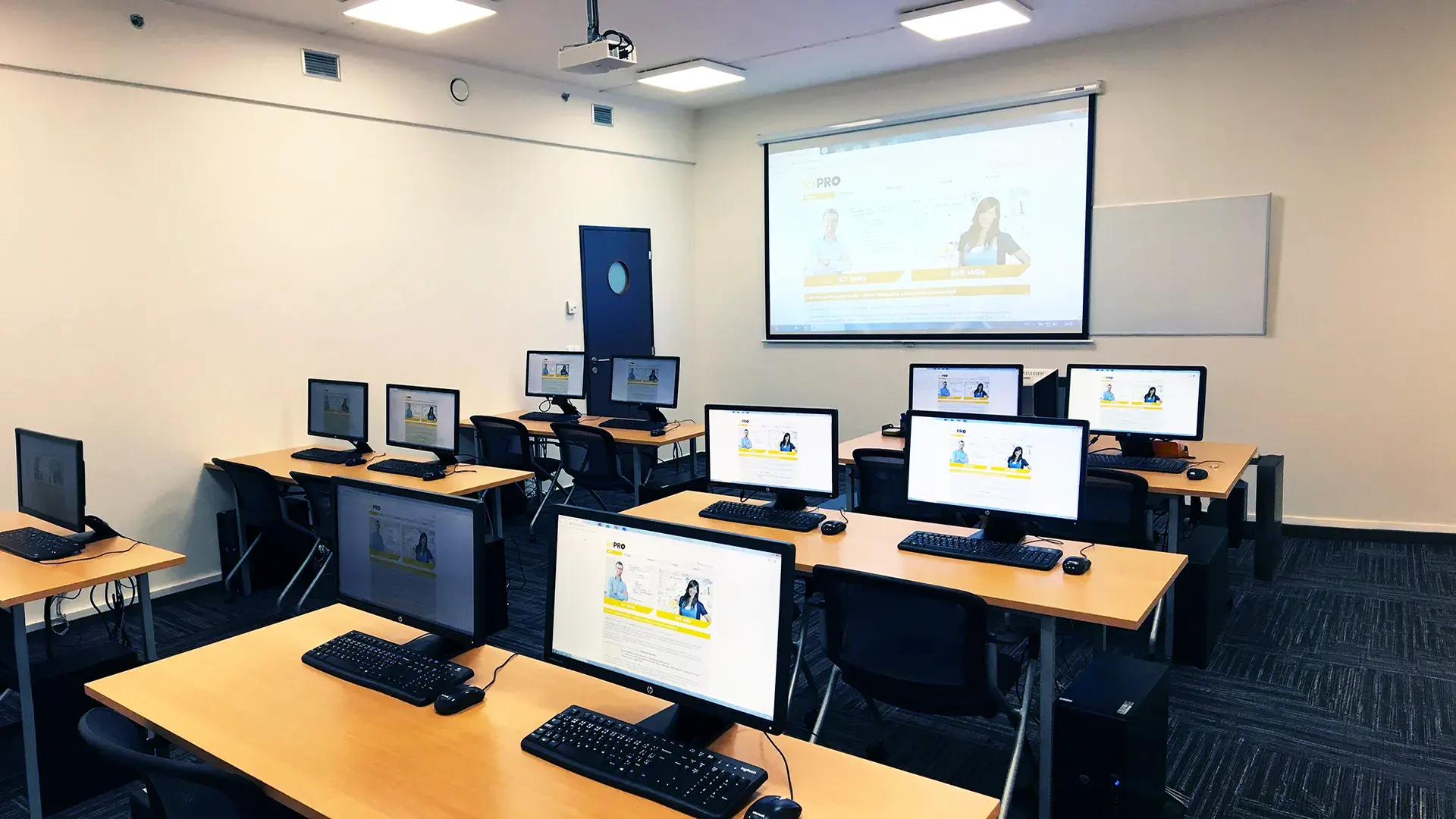 What does the environment for in-person IT courses look like?We hold training courses in our own classrooms equipped with modern computer equipment for each participant and a large projection screen. Each workstation is fitted with a powerful computer for seamless practical exercises, and the environment supports a calm, friendly atmosphere during training.
 Do I need to bring my own laptop to the classroom IT course?Our training rooms are fully equipped, so you do not need to bring your own laptop. A modern computer with all necessary hardware and software is ready for you at your workstation.
 Will you receive an official certificate after completing an IT course?Yes, upon successful completion of the training course, you will receive an official ICT Pro certificate confirming your participation and acquired technical skills. You can use it to verify your qualifications or add it to your professional profile.
 Where can you find our training center in Brno?The premises of the ICT Pro training center are located on the 1st floor of the COMGUARD building at Sochorova 38 in Brno. Positioned on the border of Žabovřesky and Komín, the location is easily accessible by both car and public transport.
 Where can you find our training center in Prague?The premises of the ICT Pro training center are located on the 1st floor of the Opatov Park building at Líbalova 1, Prague 11 – Chodov. The location provides a comfortable environment for your education with convenient access.
 What facilities and refreshments are available to you during training breaks?Our training centers feature a fully equipped kitchenette for a comfortable break during your courses. The facilities include a coffee machine, microwave, kettle, and a wide selection of drinks and snacks.
 What beverage refreshments are available during your course?A beverage station with a coffee machine, teas, syrups, and water is at your disposal throughout the entire training session. You can enjoy a coffee or another drink of your choice anytime during breaks.
 What light refreshments are provided for you during the courses?During course breaks, participants can enjoy light sweet snacks, pastries, and fruit syrups to mix their own drinks. Fresh water dispenser and plates are also available for your convenience.
 Should I bring my own snacks to ICT Pro training?There is no need to. A wide selection of savory snacks, sweet biscuits, and snack bars is available for you during breaks. Boost your energy for all-day focus right inside the training center premises.
 Can you spend training breaks in the fresh air?Yes, an outdoor terrace is available at our training center. During breaks between learning sessions, you can relax in the fresh air in a pleasant green environment.
 Where can you relax during course breaks?Our training center features a spacious outdoor terrace with seating options. During breaks between learning sessions, you can step outside to relax and recharge in the fresh air.