Advanced Networking in Cisco Environments (CCNP)
Networking, Cisco
This course builds on basic Cisco networking and dives into LAN redundancy and advanced routing. You will study STP, EtherChannel and FHRP, plus multi-area routing concepts such as OSPF to improve scalability and resilience.
Practical labs focus on IPv6 exercises and secure access using 802.1X, with site-to-site IPsec VPN configuration. You will explore VRF routing and get an overview of BGP for multi-homed enterprise connectivity and segmentation.
THIS TRAINING COURSE WILL HELP YOU:
- Understand OSPF architecture and single vs multi-area deployment
- Design and configure OSPF areas, LSA types and router roles
- Summarize and filter routes to optimize routing tables
- Implement multi-area OSPF and advanced LAN/WAN setups
- Troubleshoot and tune network performance using OSPF stats
WHO SHOULD ATTEND?
- Network specialists preparing for Cisco CCNP
- Administrators managing multi-area OSPF networks
- Technicians implementing advanced routing strategies
- Engineers focused on network performance and scalability
- IT pros upgrading CCNA skills toward CCNP-level knowledge
COURSE LOCATION AND AVAILABLE DATES
10–12 Feb 2027
752 €
CZECH
Praha + online (optional)
9–11 Nov 2026
752 €
CZECH
26–28 Apr 2027
752 €
CZECH
Need this course in English?
Public courses are usually delivered in Czech, but this course is also available in English. We can arrange private training for your team online, at your premises or in our classrooms, and tailor the content to your needs.
For groups of around 4 or more participants, private training can already be comparable in price to booking individual places on a public course. Send us your requirements and we’ll recommend the best format and provide an exact quote.
Request training in English
Course content:
Hide details
-
TCP/IP recap
-
Packet forwarding on L2 and L3 devices
-
IPv4 and IPv6 protocol overview
-
Role of firewalls and VPNs
-
Basic application services
-
Redundancy and load balancing in switched networks
-
L2 loops: detection and mitigation
-
Advanced STP configuration
-
STP acceleration features
-
Differences between PVST+, RSTP, MST
-
MST implementation
-
Link aggregation (EtherChannel)
-
Default gateway redundancy
-
Comparison of FHRP protocols
-
Configuring HSRP, VRRP, GLBP for IPv4 and IPv6
-
Failure and failover tests
-
Reasons for preemptive vs non-preemptive behavior
-
HSRP object tracking
-
IP routing
-
Route lookup and IP forwarding
-
Longest match, default route, next hop
-
Route preference and selection
-
Types of routing metrics
-
L3 load balancing and redundancy
-
Control vs forwarding plane, RIB/FIB
-
Policy-Based Routing (PBR)
-
OSPF single-area
-
Limits of single-area in large networks
-
Area concepts and design
-
LSA types (1-5 and 7)
-
Router roles: internal, ABR, ASBR
-
Route filtering techniques
-
Route summarization
-
Stub, total stub and NSSA areas
-
Configuring multi-area OSPF in enterprise LANs
-
EIGRP
-
EIGRP protocol specifics
-
Composite metric calculation
-
Alternative path computation
-
Unequal-cost load balancing
-
Route summarization
-
Route redistribution to other protocols
-
Practical EIGRP implementations including EIGRPv6
-
VRF and MPLS
-
Working with virtual routing instances
-
Import and export of routes between VRFs
-
VRF-Lite configuration on Cisco switches
-
MPLS concepts overview
-
Introduction to MPLS L3 VPNs
-
Border Gateway Protocol
-
BGP protocol and IGP differences
-
BGP path selection and attributes
-
Route summarization and filtering in BGP
-
BGP and IPv6 (MP-BGP)
-
BGP configuration for dual-connectivity (multihoming)
-
Tunneling
-
Overlay tunneling concepts
-
GRE tunnel configuration
-
Tunneling IPv6 over IPv4 provider networks
-
Site-to-site IPsec tunnel configuration
-
VXLAN concept overview
-
Network monitoring and security
-
Advanced ACLs including IPv6
-
AAA concepts
-
User access control with IEEE 802.1X (NAC)
-
Centralized authentication for device management
-
IP SLA monitoring
-
Port mirroring (SPAN/RSPAN)
-
NetFlow
-
Prerequisites:
-
Familiarity with network OS and technologies, solid TCP/IP knowledge and basic Cisco router experience.
-
Recommended previous course:
-
Basics of Networking in a Cisco Environment – CCNA Bootcamp (CCNA)
-
Schedule:
-
3 days (9:00-17:00)
-
Price per person:
-
752.00 € ( 909.92 € incl. 21% VAT)
Training and learning environment
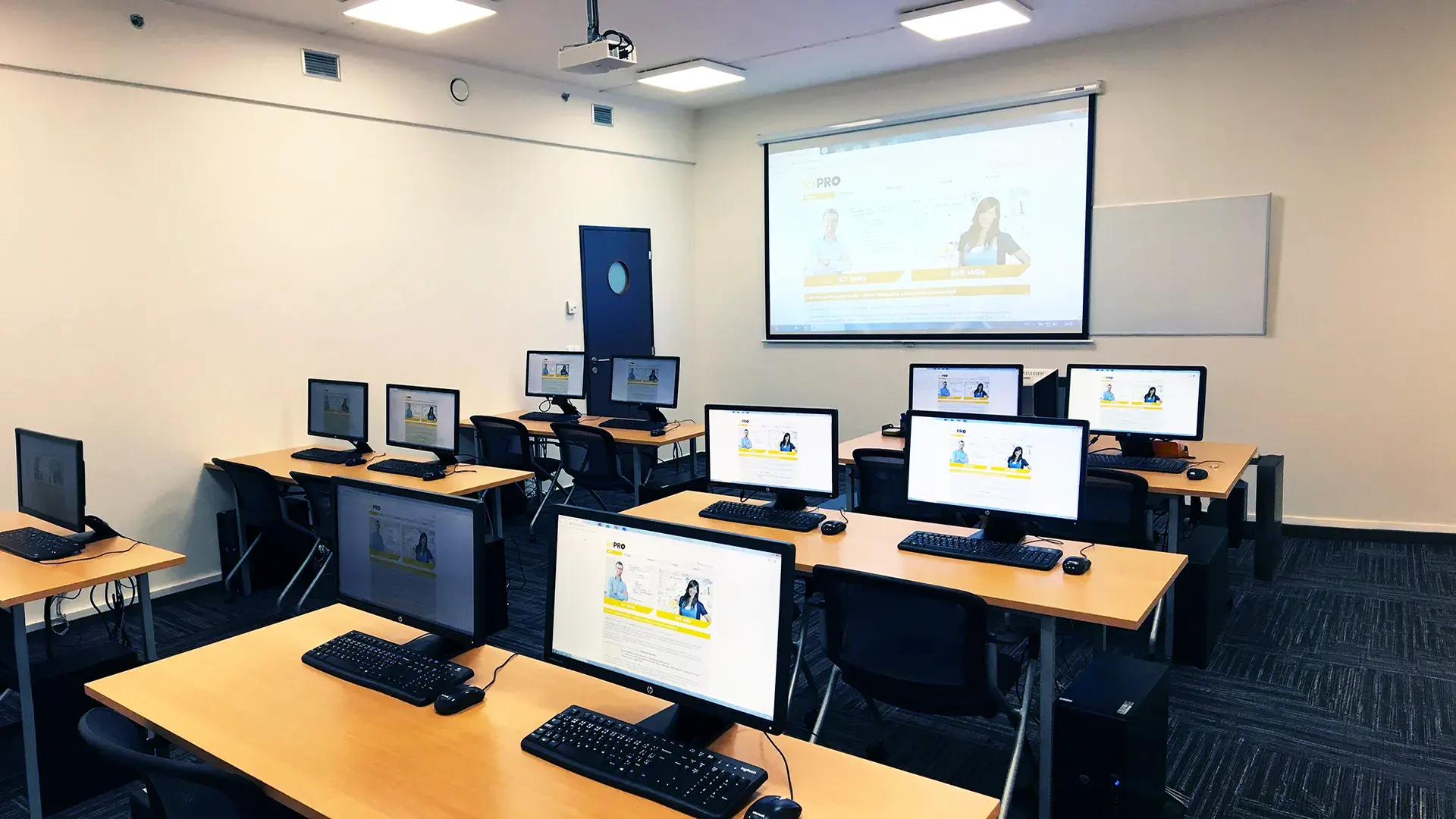 What does the environment for in-person IT courses look like?We hold training courses in our own classrooms equipped with modern computer equipment for each participant and a large projection screen. Each workstation is fitted with a powerful computer for seamless practical exercises, and the environment supports a calm, friendly atmosphere during training.
 Do I need to bring my own laptop to the classroom IT course?Our training rooms are fully equipped, so you do not need to bring your own laptop. A modern computer with all necessary hardware and software is ready for you at your workstation.
 Will you receive an official certificate after completing an IT course?Yes, upon successful completion of the training course, you will receive an official ICT Pro certificate confirming your participation and acquired technical skills. You can use it to verify your qualifications or add it to your professional profile.
 Where can you find our training center in Brno?The premises of the ICT Pro training center are located on the 1st floor of the COMGUARD building at Sochorova 38 in Brno. Positioned on the border of Žabovřesky and Komín, the location is easily accessible by both car and public transport.
 Where can you find our training center in Prague?The premises of the ICT Pro training center are located on the 1st floor of the Opatov Park building at Líbalova 1, Prague 11 – Chodov. The location provides a comfortable environment for your education with convenient access.
 What facilities and refreshments are available to you during training breaks?Our training centers feature a fully equipped kitchenette for a comfortable break during your courses. The facilities include a coffee machine, microwave, kettle, and a wide selection of drinks and snacks.
 What beverage refreshments are available during your course?A beverage station with a coffee machine, teas, syrups, and water is at your disposal throughout the entire training session. You can enjoy a coffee or another drink of your choice anytime during breaks.
 What light refreshments are provided for you during the courses?During course breaks, participants can enjoy light sweet snacks, pastries, and fruit syrups to mix their own drinks. Fresh water dispenser and plates are also available for your convenience.
 Should I bring my own snacks to ICT Pro training?There is no need to. A wide selection of savory snacks, sweet biscuits, and snack bars is available for you during breaks. Boost your energy for all-day focus right inside the training center premises.
 Can you spend training breaks in the fresh air?Yes, an outdoor terrace is available at our training center. During breaks between learning sessions, you can relax in the fresh air in a pleasant green environment.
 Where can you relax during course breaks?Our training center features a spacious outdoor terrace with seating options. During breaks between learning sessions, you can step outside to relax and recharge in the fresh air.