Ansible in Practice: Server and Application Automation (ANSBL)
Virtualization, Management
Ansible is a widely used tool for automating IT operations. This hands-on course takes you from installation and configuration through practical use of modules and playbooks, showing how to manage servers, networks and applications in cloud and on-premises environments.
The course is practical and example-driven, focusing on templates, variables and Vault encryption to secure deployments. You will also learn to use roles and collections, integrate with cloud providers and explore GUI tools for automation control and monitoring.
THIS TRAINING COURSE WILL HELP YOU:
- Understand how Ansible works and its advantages
- Install and configure Ansible on workstation and servers
- Automate systems using modules, playbooks and collections
- Use templates and Vault encryption for secure deployments
- Work with GUI tools like Semaphore and Automation Platform
WHO SHOULD ATTEND?
- System administrators wanting to streamline infrastructure management
- DevOps engineers seeking flexible deployment automation
- Developers wanting automated application deployment workflows
- IT professionals managing hybrid on-premise and cloud environments
COURSE LOCATION AND AVAILABLE DATES
15–16 Feb 2027
392 €
CZECH
26–27 Apr 2027
392 €
CZECH
Praha + online (optional)
17–18 Mar 2027
392 €
CZECH
Need this course in English?
Public courses are usually delivered in Czech, but this course is also available in English. We can arrange private training for your team online, at your premises or in our classrooms, and tailor the content to your needs.
For groups of around 4 or more participants, private training can already be comparable in price to booking individual places on a public course. Send us your requirements and we’ll recommend the best format and provide an exact quote.
Request training in English
Course content:
Hide details
-
Introduction
-
General introduction to automation
-
What is Ansible
-
How it works
-
Uses, advantages and disadvantages
-
Comparison with other tools ("Puppet", "Chef")
-
Installing Ansible
-
Ansible requirements
-
Setting up the controller/workstation (Mac, Linux, Windows)
-
Connecting to remote servers, devices, private or public cloud
-
Inventory
-
How to define an inventory — the list of servers you manage with Ansible
-
Hierarchy — grouping into hosts and groups
-
Modules
-
Running individual modules, commands and tasks on remote systems
-
Roles & Collections
-
Installing and using existing collections and roles
-
Sharing and installing roles/collections — Ansible Galaxy (GitHub/GitLab …)
-
Practical examples
-
Playbooks
-
Defining hosts
-
List of tasks
-
Structuring code
-
Using multiple playbooks
-
Format (YAML)
-
Defining variables
-
Ansible Facts
-
Controlling Ansible execution — Basics
-
Conditions — run when...
-
Loops — repeat tasks
-
Errors — error handling and debugging
-
Templates
-
Using templates to generate files — basics
-
Encryption (Vault)
-
Encrypting sensitive information (passwords, tokens…)
-
Graphical interfaces for Ansible (demo)
-
Ansible Semaphore
-
Ansible Automation Platform
-
Troubleshooting common issues
-
Deploying applications with Ansible — practical examples
-
Ansible project of your choice
-
Q&A, discussion and wrap-up
-
Prerequisites:
-
Basic experience with Linux and the Linux shell.
-
Recommended follow-up course:
-
Ansible in Practice: Advanced Server and Application Automation (ANSBL2)
-
Schedule:
-
2 days (9:00-17:00)
-
Price per person:
-
392.00 € ( 474.32 € incl. 21% VAT)
Training and learning environment
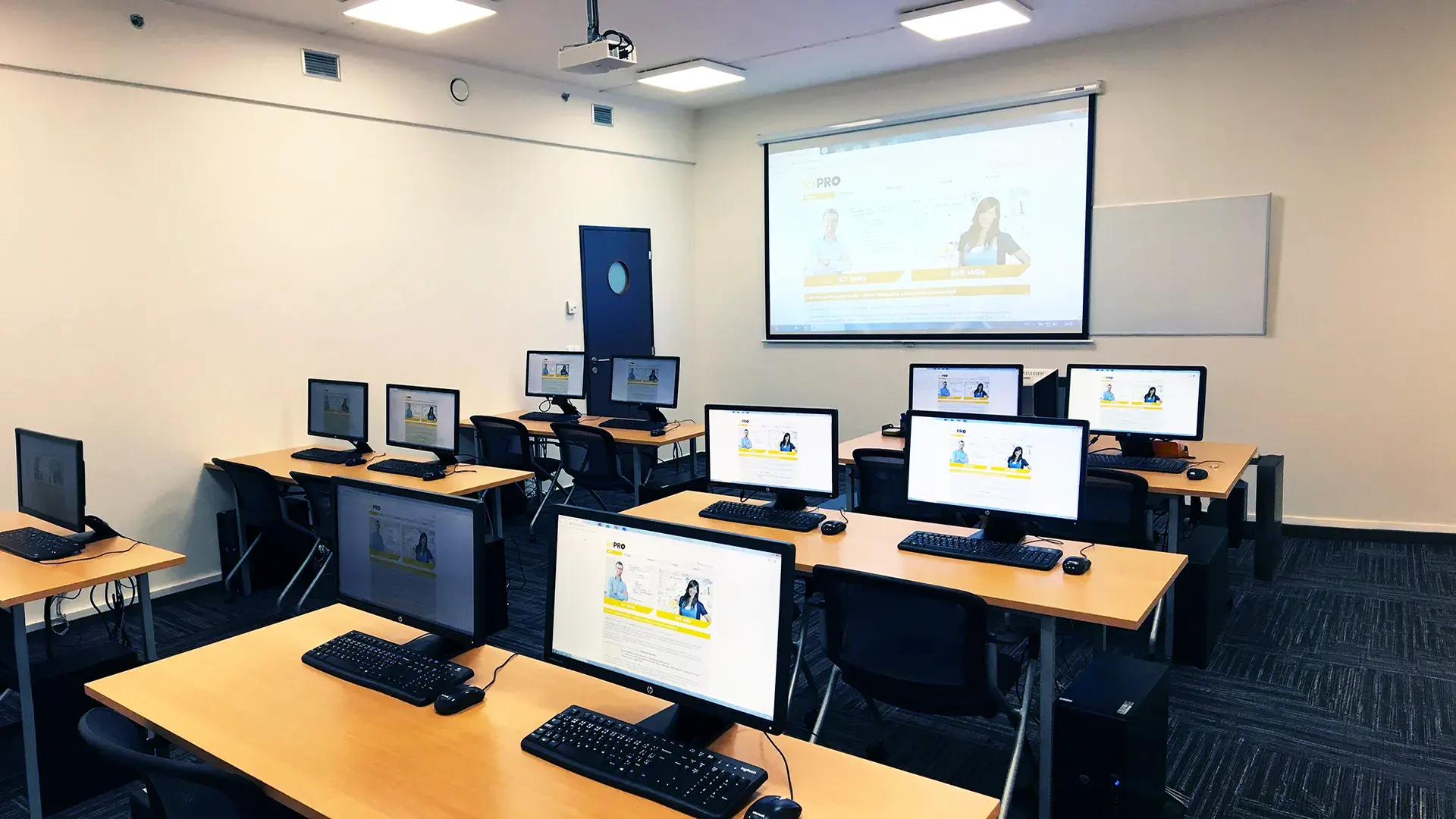 What does the environment for in-person IT courses look like?We hold training courses in our own classrooms equipped with modern computer equipment for each participant and a large projection screen. Each workstation is fitted with a powerful computer for seamless practical exercises, and the environment supports a calm, friendly atmosphere during training.
 Do I need to bring my own laptop to the classroom IT course?Our training rooms are fully equipped, so you do not need to bring your own laptop. A modern computer with all necessary hardware and software is ready for you at your workstation.
 Will you receive an official certificate after completing an IT course?Yes, upon successful completion of the training course, you will receive an official ICT Pro certificate confirming your participation and acquired technical skills. You can use it to verify your qualifications or add it to your professional profile.
 Where can you find our training center in Brno?The premises of the ICT Pro training center are located on the 1st floor of the COMGUARD building at Sochorova 38 in Brno. Positioned on the border of Žabovřesky and Komín, the location is easily accessible by both car and public transport.
 Where can you find our training center in Prague?The premises of the ICT Pro training center are located on the 1st floor of the Opatov Park building at Líbalova 1, Prague 11 – Chodov. The location provides a comfortable environment for your education with convenient access.
 What facilities and refreshments are available to you during training breaks?Our training centers feature a fully equipped kitchenette for a comfortable break during your courses. The facilities include a coffee machine, microwave, kettle, and a wide selection of drinks and snacks.
 What beverage refreshments are available during your course?A beverage station with a coffee machine, teas, syrups, and water is at your disposal throughout the entire training session. You can enjoy a coffee or another drink of your choice anytime during breaks.
 What light refreshments are provided for you during the courses?During course breaks, participants can enjoy light sweet snacks, pastries, and fruit syrups to mix their own drinks. Fresh water dispenser and plates are also available for your convenience.
 Should I bring my own snacks to ICT Pro training?There is no need to. A wide selection of savory snacks, sweet biscuits, and snack bars is available for you during breaks. Boost your energy for all-day focus right inside the training center premises.
 Can you spend training breaks in the fresh air?Yes, an outdoor terrace is available at our training center. During breaks between learning sessions, you can relax in the fresh air in a pleasant green environment.
 Where can you relax during course breaks?Our training center features a spacious outdoor terrace with seating options. During breaks between learning sessions, you can step outside to relax and recharge in the fresh air.