LLM application security according to OWASP Top 10 (2026) (OWASPAI)
Cybersecurity, AI & Security
This course introduces the security specifics of LLM applications and how they differ from traditional systems. You will learn about OWASP Top 10 for LLM Applications (2026), secure mindset principles, and the impact of real-world security incidents in the context of DevSecOps, MLOps, and security culture.
You will examine the main risks, including prompt injection, sensitive information disclosure, excessive agency, supply chain vulnerabilities, poisoned data, misinformation, and improper output handling. You will gain an overview of prevention and detection, permission management, data and output validation, monitoring, and connections to red teaming, incident response, EU AI Act, NIST AI RMF, and MITRE ATLAS.
THIS TRAINING COURSE WILL HELP YOU:
- Understand the differences between LLM applications and traditional applications from a security perspective
- Learn about the main risks according to OWASP Top 10 for LLM Applications
- Recognize attack types such as prompt injection, sensitive information disclosure, and excessive agency
- Design risk prevention and detection measures using permission management, validation, monitoring, and other controls
- Address security risks related to the supply chain, training data, RAG, and vector databases
- Reduce risks associated with hallucinations, improper output handling, and unbounded consumption
- Integrate LLM application security into the SDLC, DevSecOps, monitoring, and incident response
WHO SHOULD ATTEND?
- LLM application developers
- Security architects and specialists
- DevSecOps and MLOps specialists
- Administrators of systems using generative AI
- Specialists in red teaming and LLM application testing
COURSE LOCATION AND AVAILABLE DATES
Filter dates:
DateLocationFormat
LanguagePrice
PrahaPraha (hybrid)
Hybrid
This session takes place simultaneously in the classroom and online. You can choose your preferred way to attend during registration.
Czech
656 € 794 € incl. VAT
PrahaPraha (hybrid)
Hybrid
This session takes place simultaneously in the classroom and online. You can choose your preferred way to attend during registration.
Czech
656 € 794 € incl. VAT
Need this course in English?
Course content:
Hide details
-
Introduction to LLM application security
-
How LLM applications differ from traditional applications: nondeterminism, blending of instructions and data
-
Attacker mindset and secure mindset principles for LLM-based systems
-
Summary of known real-world incidents and their impact
-
Introduction to OWASP GenAI Security Project and the importance of Top 10 for LLM Applications
-
Relationship to DevSecOps, MLOps, and corporate security culture
-
LLM01: Prompt Injection
-
Why it occurs: the model does not distinguish instructions from data
-
Most common types: direct and indirect injection (documents, websites, emails), jailbreaks, multimodal inputs
-
Examples of real-world incidents: EchoLeak in Microsoft 365 Copilot, Chevrolet dealer chatbot
-
Prevention and detection: separating untrusted content, limiting permissions, filtering, monitoring
-
LLM02: Sensitive Information Disclosure
-
Why leaks occur: sensitive data in prompts, context, training data, and logs
-
Most common types: disclosure of personal data, corporate secrets, and credentials
-
Examples of real-world incidents: Samsung source code leak through ChatGPT
-
Prevention and detection: data minimization, access control for context, DLP, output redaction
-
LLM03: Excessive Agency
-
Why it occurs: the model is given more functions, permissions, and autonomy than it needs
-
Most common types: overly broad tools, excessive permissions, actions without approval
-
Examples of real-world incidents: Replit agent deleting a production database
-
Prevention and detection: least privilege, human-in-the-loop, audit trail of actions
-
LLM04: Supply Chain
-
Why the LLM supply chain is broader: models, datasets, adapters, plugins
-
Most common types: compromised models, vulnerable libraries, untrusted sources
-
Examples of real-world incidents: malicious models on Hugging Face (pickle)
-
Prevention and detection: provenance verification, AI/ML BOM, artifact scanning
-
LLM05: Data and Model Poisoning
-
Why it occurs: untrusted data in training, fine-tuning, and RAG
-
Most common types: backdoors, poisoned knowledge bases, feedback manipulation
-
Examples: PoisonGPT demonstration and impact on recommendations and decision-making
-
Prevention and detection: data provenance checks, validation, model behavior testing
-
LLM06: Unbounded Consumption
-
Why it occurs: costly inference without limits or consumption controls
-
Most common types: denial of service, denial of wallet, model extraction
-
Examples of real-world incidents and improper implementations
-
Prevention and detection: rate limiting, quotas, budgets, anomaly monitoring
-
LLM07: Misinformation
-
Why it occurs: hallucinations and users' excessive trust in outputs
-
Most common types: fabricated facts and citations, nonexistent packages (slopsquatting)
-
Examples of real-world incidents: Air Canada chatbot, fabricated court precedents
-
Prevention and detection: grounding in sources, verification, human review, communicating limitations
-
LLM08: Hidden Context Exposure
-
Why it occurs: hidden context is not a security boundary
-
Most common types: disclosure of system prompts, tool schemas, policies, and secrets
-
Examples of real-world incidents: Bing Chat system prompt disclosure (“Sydney”)
-
Prevention and detection: no secrets in context, enforcing rules outside the model
-
LLM09: Vector and Embedding Weaknesses
-
Why errors occur in RAG and vector databases
-
Most common types: missing access control, cross-tenant leakage, poisoned documents, embedding inversion
-
Examples of real-world incidents and improper implementations
-
Prevention and detection: document-level permissions, tenant isolation, source validation
-
LLM10: Improper Output Handling
-
Why it occurs: model output is treated as trusted
-
Most common types: XSS, SSRF, SQL injection, code execution, exfiltration through Markdown
-
Examples of real-world incidents and improper implementations
-
Prevention and detection: output validation and encoding, sandboxing, zero trust toward the model
-
Summary and related topics
-
Agentic systems and OWASP Top 10 for Agentic Applications
-
Red teaming and automated testing of LLM applications
-
Integration into the SDLC, monitoring, and incident response
-
Regulations and frameworks: EU AI Act, NIST AI RMF, MITRE ATLAS
-
Schedule:
-
2 days (9:00-17:00)
-
Price per person:
-
656.00 € ( 793.76 € incl. 21% VAT)
Training and learning environment
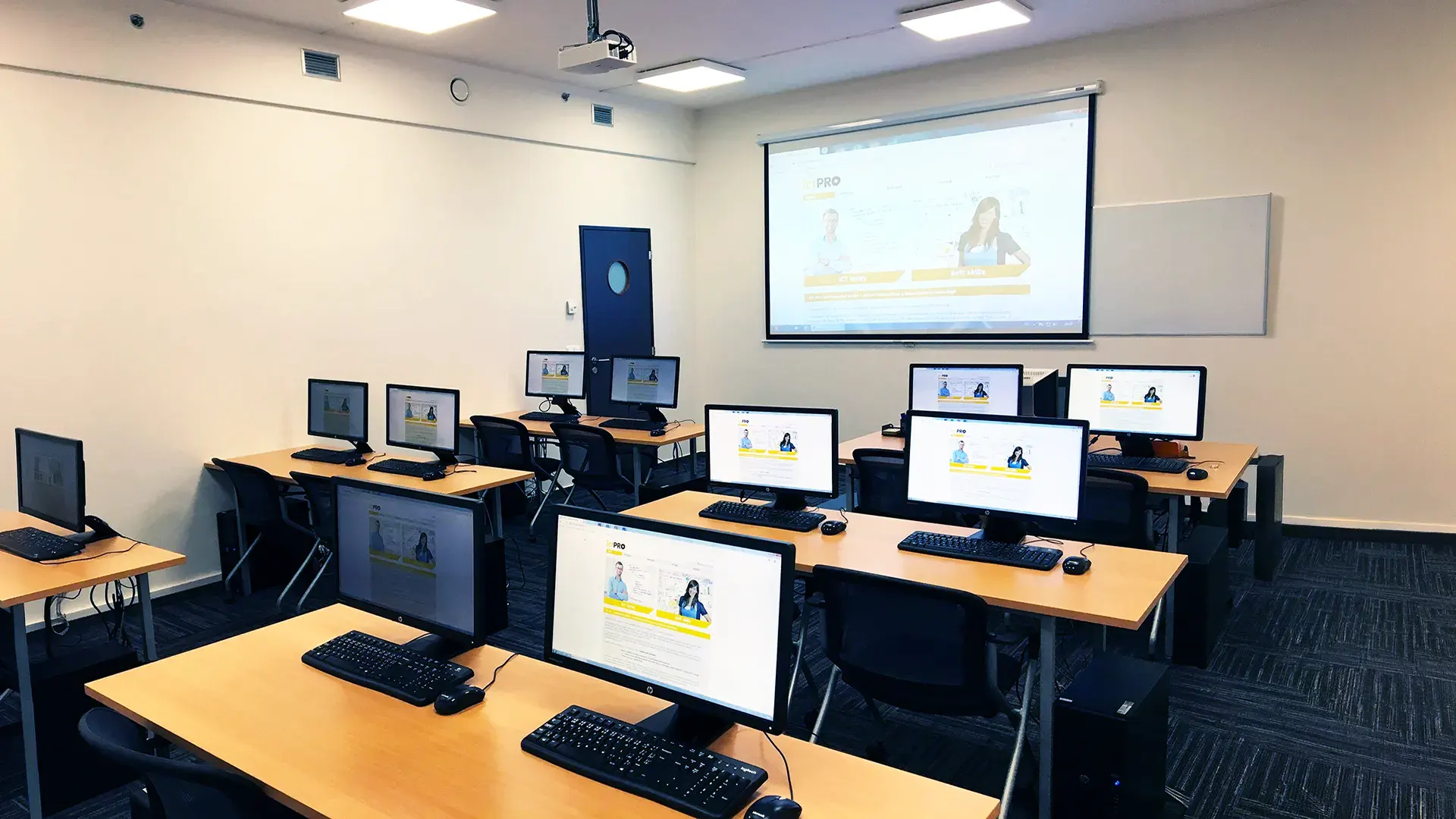 What does the environment for in-person IT courses look like?We hold training courses in our own classrooms equipped with modern computer equipment for each participant and a large projection screen. Each workstation is fitted with a powerful computer for seamless practical exercises, and the environment supports a calm, friendly atmosphere during training.
 Do I need to bring my own laptop to the classroom IT course?Our training rooms are fully equipped, so you do not need to bring your own laptop. A modern computer with all necessary hardware and software is ready for you at your workstation.
 Will you receive an official certificate after completing an IT course?Yes, upon successful completion of the training course, you will receive an official ICT Pro certificate confirming your participation and acquired technical skills. You can use it to verify your qualifications or add it to your professional profile.
 Where can you find our training center in Brno?The premises of the ICT Pro training center are located on the 1st floor of the COMGUARD building at Sochorova 38 in Brno. Positioned on the border of Žabovřesky and Komín, the location is easily accessible by both car and public transport.
 Where can you find our training center in Prague?The premises of the ICT Pro training center are located on the 1st floor of the Opatov Park building at Líbalova 1, Prague 11 – Chodov. The location provides a comfortable environment for your education with convenient access.
 What facilities and refreshments are available to you during training breaks?Our training centers feature a fully equipped kitchenette for a comfortable break during your courses. The facilities include a coffee machine, microwave, kettle, and a wide selection of drinks and snacks.
 What beverage refreshments are available during your course?A beverage station with a coffee machine, teas, syrups, and water is at your disposal throughout the entire training session. You can enjoy a coffee or another drink of your choice anytime during breaks.
 What light refreshments are provided for you during the courses?During course breaks, participants can enjoy light sweet snacks, pastries, and fruit syrups to mix their own drinks. Fresh water dispenser and plates are also available for your convenience.
 Should I bring my own snacks to ICT Pro training?There is no need to. A wide selection of savory snacks, sweet biscuits, and snack bars is available for you during breaks. Boost your energy for all-day focus right inside the training center premises.
 Can you spend training breaks in the fresh air?Yes, an outdoor terrace is available at our training center. During breaks between learning sessions, you can relax in the fresh air in a pleasant green environment.
 Where can you relax during course breaks?Our training center features a spacious outdoor terrace with seating options. During breaks between learning sessions, you can step outside to relax and recharge in the fresh air.