SQL Server – Advanced Administration (MSQL2)
Databases, Microsoft SQL
This course is designed for administrators with basic SQL Server skills who want to master advanced administration of the database engine. It covers planning, installation, configuration, security hardening and strategies to maintain performance and high availability.
Topics include hardware and storage planning, tempdb and transaction log design, full-text search, partitioning, compression and Filestream, change capture, and advanced backup and recovery. You will also study replication and performance tuning.
THIS TRAINING COURSE WILL HELP YOU:
- Manage and configure advanced SQL Server components
- Design backup, restore and point-in-time recovery plans
- Implement high availability and replication solutions
- Troubleshoot and tune server and query performance
WHO SHOULD ATTEND?
- DBAs with basic SQL Server experience
- Windows server administrators working with SQL Server
- Developers who need deeper DBA knowledge
- IT architects planning SQL Server solutions
COURSE LOCATION AND AVAILABLE DATES
This public course is delivered online only, so you can attend remotely without travelling to a classroom. The same course can also be delivered in person as private training at your premises.
For technically demanding courses, prepared remote labs are provided, so you do not need to install anything locally.
21–22 Jan 2027
476 €
CZECH
Need this course in English?
Public courses are usually delivered in Czech, but this course is also available in English. We can arrange private training for your team online, at your premises or in our classrooms, and tailor the content to your needs.
For groups of around 4 or more participants, private training can already be comparable in price to booking individual places on a public course. Send us your requirements and we’ll recommend the best format and provide an exact quote.
Request training in English
Course content:
Hide details
-
Introduction to advanced administration
-
Installing SQL Server and planning for performance, stability and HA
-
Hardware and software requirements
-
Storage types and choosing the right option
-
Planning user databases, tempdb, and the transaction log
-
Full-text indexes
-
Full-text search in SQL Server
-
Creating and managing full-text indexes
-
Using CONTAINS and FREETEXT predicates
-
Full-text functions
-
Differences between full-text predicates and functions
-
Combining full-text with SQL queries
-
Advanced data management
-
Partition functions and schemes
-
Partitioning tables and indexes
-
Querying data in partitions
-
Managing partitions
-
Partition switching for fast data movement between tables
-
Data and index compression, including partition-level compression
-
Filestream — storing binary data in files on disk
-
Change Tracking and Change Data Capture
-
Advanced database and server settings
-
Advanced backup and recovery
-
Backup types: full, differential, transaction log
-
Transaction log concepts
-
Point-in-time recovery
-
Page restore
-
Filegroup and file restore
-
Piecemeal restore
-
Introduction to high availability (HA) — options and principles
-
Continuous availability solutions in SQL Server
-
Failover clustering
-
AlwaysOn Availability Groups (2012)
-
Database mirroring
-
Log shipping
-
Troubleshooting and performance tuning
-
Troubleshooting SQL Servers and using DMVs
-
SQL Profiler and SQLDiag — capturing workload
-
Database Engine Tuning Advisor — automated tuning
-
Resource Governor — limiting resources for workloads
-
Data Collector and Utility Control Points
-
Dedicated Administrator Connection (DAC)
-
Replication
-
Overview of replication in SQL Server
-
Replication types and topologies
-
Implementing and configuring replication
-
Creating publications and subscriptions
-
Snapshot, merge and transactional replication
-
Peer-to-Peer transactional replication
-
HTTP Merge Replication
-
Overview of other SQL Server components
-
Analysis Services — OLAP cubes and data mining
-
Reporting Services — reporting
-
PowerPivot and Power View — self-service BI
-
Integration Services — ETL and data warehousing
-
StreamInsight
-
Master Data Services
-
Data Quality Services
-
SQL Azure — SQL Server in the cloud
-
PowerShell provider
-
Service Broker — asynchronous messaging
-
Native web services
-
Prerequisites:
-
Basic Windows Server administration and basic SQL Server administration experience.
-
Recommended previous course:
-
SQL Server Administration (MSQL1)
-
Recommended follow-up course:
-
MS SQL Server – Comprehensive Performance Optimization (MSQL3)
-
Schedule:
-
2 days (9:00-17:00)
-
Price per person:
-
476.00 € ( 575.96 € incl. 21% VAT)
Training and learning environment
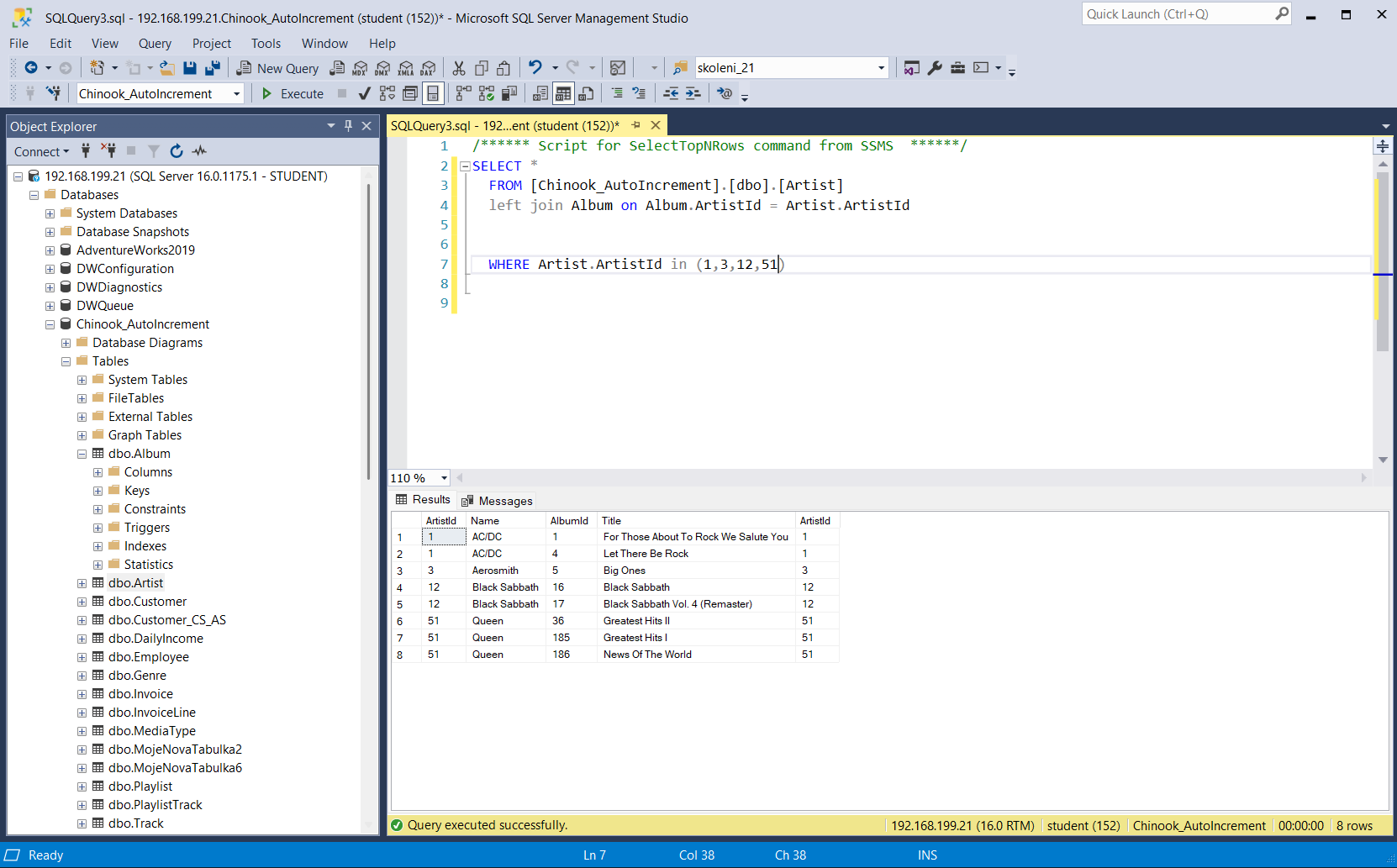 How does practical SQL query training look like?During the training, you work directly in SQL Server Management Studio, writing your own T-SQL queries and joining tables. You will immediately verify your code on real datasets and learn how to filter data effectively.
 What does the environment for in-person IT courses look like?We hold training courses in our own classrooms equipped with modern computer equipment for each participant and a large projection screen. Each workstation is fitted with a powerful computer for seamless practical exercises, and the environment supports a calm, friendly atmosphere during training.
 Do I need to bring my own laptop to the classroom IT course?Our training rooms are fully equipped, so you do not need to bring your own laptop. A modern computer with all necessary hardware and software is ready for you at your workstation.
 Will you receive an official certificate after completing an IT course?Yes, upon successful completion of the training course, you will receive an official ICT Pro certificate confirming your participation and acquired technical skills. You can use it to verify your qualifications or add it to your professional profile.
 Where can you find our training center in Brno?The premises of the ICT Pro training center are located on the 1st floor of the COMGUARD building at Sochorova 38 in Brno. Positioned on the border of Žabovřesky and Komín, the location is easily accessible by both car and public transport.
 Where can you find our training center in Prague?The premises of the ICT Pro training center are located on the 1st floor of the Opatov Park building at Líbalova 1, Prague 11 – Chodov. The location provides a comfortable environment for your education with convenient access.
 What facilities and refreshments are available to you during training breaks?Our training centers feature a fully equipped kitchenette for a comfortable break during your courses. The facilities include a coffee machine, microwave, kettle, and a wide selection of drinks and snacks.
 What beverage refreshments are available during your course?A beverage station with a coffee machine, teas, syrups, and water is at your disposal throughout the entire training session. You can enjoy a coffee or another drink of your choice anytime during breaks.
 What light refreshments are provided for you during the courses?During course breaks, participants can enjoy light sweet snacks, pastries, and fruit syrups to mix their own drinks. Fresh water dispenser and plates are also available for your convenience.
 Should I bring my own snacks to ICT Pro training?There is no need to. A wide selection of savory snacks, sweet biscuits, and snack bars is available for you during breaks. Boost your energy for all-day focus right inside the training center premises.
 Can you spend training breaks in the fresh air?Yes, an outdoor terrace is available at our training center. During breaks between learning sessions, you can relax in the fresh air in a pleasant green environment.
 Where can you relax during course breaks?Our training center features a spacious outdoor terrace with seating options. During breaks between learning sessions, you can step outside to relax and recharge in the fresh air.