Secure system design and penetration testing with an AI system (HCKAI2) (HCKAI2)
Cybersecurity, ICT Security
An advanced practical course for those who want to conduct penetration tests properly with AI and use the results to design more secure systems. Participants do not install anything: throughout the course, they receive access to a prepared AI system for security testing, running on dedicated hardware with its own models, agents and knowledge base. During the first two days, they use it to carry out a complete authorized test of a laboratory company, from planning through reporting, and learn how to monitor the quality of the results. The third day focuses on design: how to derive secure architectures for applications, infrastructure and AI systems from findings, how to configure defenses, and how to build a similar system in their own organization.
THIS TRAINING COURSE WILL HELP YOU:
- Conduct a complete penetration test with a ready-made AI system, from defining the engagement scope to delivering the report
- Learn to direct agents so they remain within the engagement scope and ensure that a human approves risky actions
- Learn how to measure result quality and distinguish confirmed findings from false positives
- Translate test findings into requirements for secure architecture
- Design secure deployment of an AI system, including agent permissions, isolation, data handling and model selection
- Verify that monitoring and detection rules capture testing activity
- Take away an architecture design for such a system in your own organization
WHO SHOULD ATTEND?
- Penetration testers and security consultants
- Security architects and security team leaders
- Security analysts and SOC team members
- Architects, DevOps engineers and developers responsible for designing and operating applications and AI systems
COURSE LOCATION AND AVAILABLE DATES
Filter dates:
DateLocationFormat
LanguagePrice
PrahaPraha (hybrid)
Hybrid
This session takes place simultaneously in the classroom and online. You can choose your preferred way to attend during registration.
Czech
1,156 € 1,399 € incl. VAT
BrnoBrno (hybrid)
Hybrid
This session takes place simultaneously in the classroom and online. You can choose your preferred way to attend during registration.
Czech
1,156 € 1,399 € incl. VAT
PrahaPraha (hybrid)
Hybrid
This session takes place simultaneously in the classroom and online. You can choose your preferred way to attend during registration.
Czech
1,156 € 1,399 € incl. VAT
BrnoBrno (hybrid)
Hybrid
This session takes place simultaneously in the classroom and online. You can choose your preferred way to attend during registration.
Czech
1,156 € 1,399 € incl. VAT
PrahaPraha (hybrid)
Hybrid
This session takes place simultaneously in the classroom and online. You can choose your preferred way to attend during registration.
Czech
1,156 € 1,399 € incl. VAT
BrnoBrno (hybrid)
Hybrid
This session takes place simultaneously in the classroom and online. You can choose your preferred way to attend during registration.
Czech
1,156 € 1,399 € incl. VAT
Need this course in English?
Public courses are usually delivered in Czech, but this course is also available in English. We can arrange private training for your team online, at your premises or in our classrooms, and tailor the content to your needs.
For groups of around 4 or more participants, private training can already be comparable in price to booking individual places on a public course. Send us your requirements and we’ll recommend the best format and provide an exact quote.
Request training in English
Course content:
Hide details
-
System you will work with
-
Architecture: custom models, agents, knowledge base, laboratory and logging
-
What the custom model does in the system and where a cloud model helps
-
Participant access, roles and working rules
-
Laboratory isolation and participant separation
-
Methodology for effective AI-assisted testing
-
Engagement scope and client authorization as input for agents
-
Test plan, hypotheses and sequence of steps
-
What to delegate to the agent and what the tester must decide
-
Step logging as a basis for reporting and auditing
-
Reconnaissance and attack surface mapping
-
Reconnaissance of the laboratory company using available sources
-
Model-based evaluation of scanner outputs and noise filtering
-
Linking findings to CVE, CISA KEV and EPSS databases
-
Prioritization based on actual risk
-
Workshop
-
Configure the engagement in the system, perform reconnaissance and compile a prioritized list of hypotheses
-
Agents for finding validation
-
Workflow: reconnaissance, evaluation, validation
-
Guardrails: the agent must not leave the engagement scope; a human approves risky actions
-
From a scanner record to a confirmed finding in the laboratory
-
Applications, APIs and AI services
-
Web applications and APIs (OWASP Top 10, OWASP API Security Top 10)
-
AI services in the tested company: chatbots, RAG, agents and MCP servers
-
Indirect prompt injection and excessive agent permissions
-
Quality and repeatability
-
False positives and findings missed by the system
-
Benchmark task set and measuring the system over time
-
When a custom model is not enough and how to safely hand a task over to a more capable model
-
Test report
-
Severity assessment (CVSS) and remediation recommendations
-
Technical and management reports compiled from logs
-
Review of AI outputs and tester accountability
-
Workshop
-
Complete the laboratory company test and submit the report
-
From findings to architecture
-
Recurring causes of findings and how to prevent them through design
-
AI-assisted threat modeling
-
Design principles: least privilege, segmentation, identity and secret key management, updates
-
Security controls in application development, including applications created with AI assistance
-
Secure AI system design
-
Agent permissions and isolation, approval of risky actions
-
Data: classification, routing between custom and cloud models, log retention
-
Security of RAG and tools connected through MCP
-
Supply chain: model provenance and integrity
-
Model servers and interfaces that must not be accessible from the internet
-
Defense and monitoring
-
Verifying that detection rules (Suricata, Sigma) capture testing activity
-
AI-assisted log analysis and incident timeline creation
-
AI in SOC operations and tester–defender collaboration
-
Custom AI system for the security team
-
Hardware and model selection based on team size
-
Operations: access rights, logging, model updates and costs
-
Implementation process: pilot, rules and training
-
Workshop
-
Design an architecture for a system in your own organization and review it with the instructor
-
Prerequisites:
-
Knowledge of working with the command line, an understanding of network and application security, and experience using an AI assistant or a custom model for security work. Recommended prerequisite course: Penetration testing with AI: Claude and custom model capabilities (HCKAI1). The course is also suitable for participants of HCK1 or HCK2 courses who have basic experience with AI models.
-
Schedule:
-
3 days (9:00-17:00)
-
Price per person:
-
1 156.00 € (1 398.76 € incl. 21% VAT)
Training and learning environment
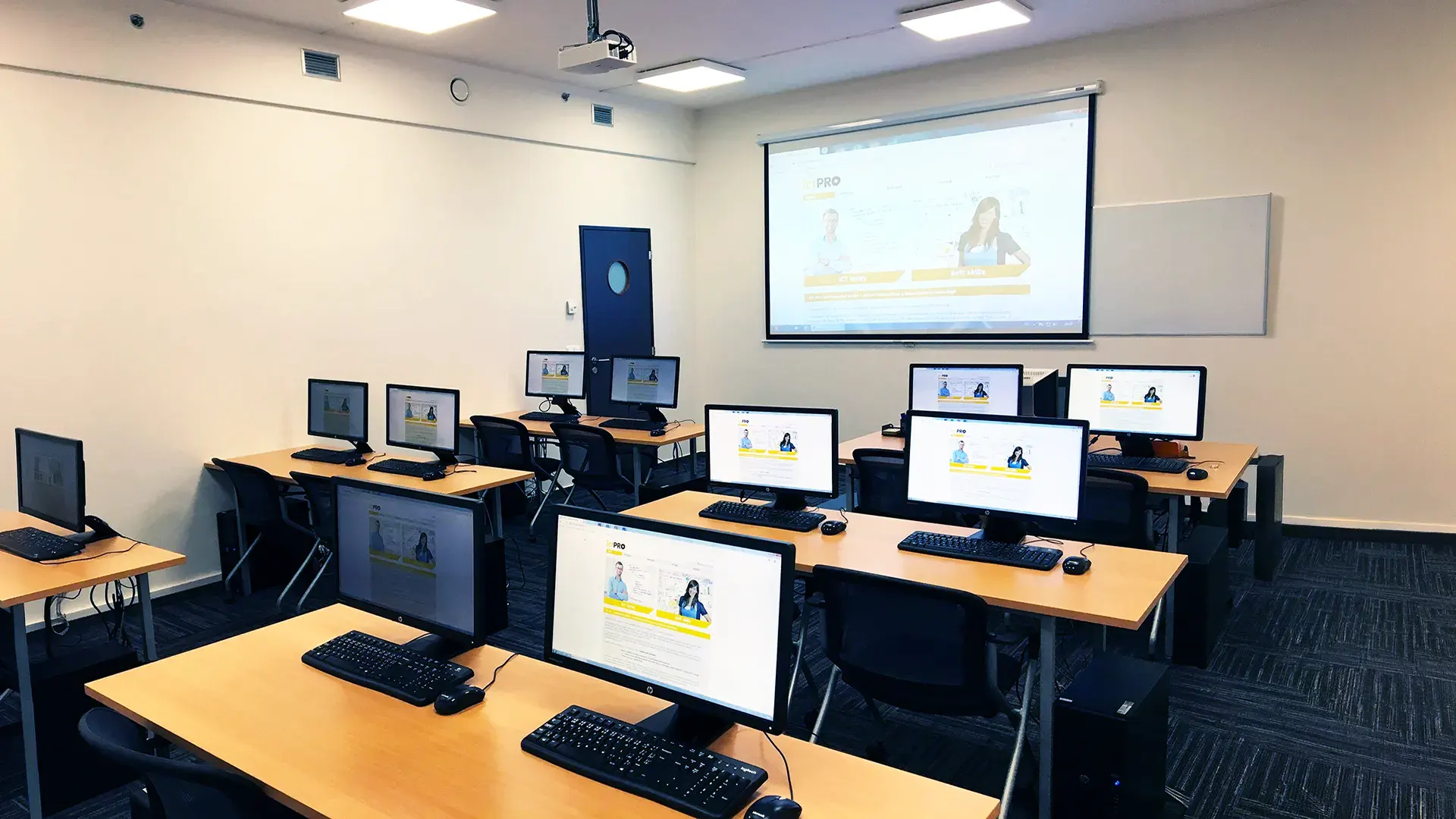 What does the environment for in-person IT courses look like?We hold training courses in our own classrooms equipped with modern computer equipment for each participant and a large projection screen. Each workstation is fitted with a powerful computer for seamless practical exercises, and the environment supports a calm, friendly atmosphere during training.
 Do I need to bring my own laptop to the classroom IT course?Our training rooms are fully equipped, so you do not need to bring your own laptop. A modern computer with all necessary hardware and software is ready for you at your workstation.
 Will you receive an official certificate after completing an IT course?Yes, upon successful completion of the training course, you will receive an official ICT Pro certificate confirming your participation and acquired technical skills. You can use it to verify your qualifications or add it to your professional profile.
 Where can you find our training center in Brno?The premises of the ICT Pro training center are located on the 1st floor of the COMGUARD building at Sochorova 38 in Brno. Positioned on the border of Žabovřesky and Komín, the location is easily accessible by both car and public transport.
 Where can you find our training center in Prague?The premises of the ICT Pro training center are located on the 1st floor of the Opatov Park building at Líbalova 1, Prague 11 – Chodov. The location provides a comfortable environment for your education with convenient access.
 What facilities and refreshments are available to you during training breaks?Our training centers feature a fully equipped kitchenette for a comfortable break during your courses. The facilities include a coffee machine, microwave, kettle, and a wide selection of drinks and snacks.
 What beverage refreshments are available during your course?A beverage station with a coffee machine, teas, syrups, and water is at your disposal throughout the entire training session. You can enjoy a coffee or another drink of your choice anytime during breaks.
 What light refreshments are provided for you during the courses?During course breaks, participants can enjoy light sweet snacks, pastries, and fruit syrups to mix their own drinks. Fresh water dispenser and plates are also available for your convenience.
 Should I bring my own snacks to ICT Pro training?There is no need to. A wide selection of savory snacks, sweet biscuits, and snack bars is available for you during breaks. Boost your energy for all-day focus right inside the training center premises.
 Can you spend training breaks in the fresh air?Yes, an outdoor terrace is available at our training center. During breaks between learning sessions, you can relax in the fresh air in a pleasant green environment.
 Where can you relax during course breaks?Our training center features a spacious outdoor terrace with seating options. During breaks between learning sessions, you can step outside to relax and recharge in the fresh air.