Strategic IT Portfolio Management for CIOs and IT Managers (STRIT) (STRIT)
Specialized training, Other
How to connect business strategy, digitalization and application investments The growing number of applications, technical debt, business requirements and limited budgets constantly force IT management to decide where to invest, what to modernize and which systems should no longer be developed.
This course presents a practical approach to strategic application portfolio management. Participants will learn how to gain an overview of the current IT environment, connect applications with business needs and prepare clear decisions about their future development. The course takes a somewhat different approach: it does not focus on memorizing architectural frameworks, but on practical know-how and the real questions CIOs and IT managers must address: What do we have? What do we actually need? Where should we invest? What should we replace? What should we discontinue? And how can we implement change without putting operations at risk? The first day focuses on strategy, inventory and portfolio assessment. The second day covers rationalization, modernization strategies, the roadmap and a practical workshop.
THIS TRAINING COURSE WILL HELP YOU:
- Develop a management perspective on the organization’s application portfolio
- Connect business strategy, business capabilities and IT investments
- Assess applications based on their value, technical condition, costs and risks
- Identify duplication, legacy systems and opportunities for rationalization
- Decide which applications to develop, tolerate, replace or discontinue
- Select an appropriate modernization or migration strategy
- Set different rates of change for stable, differentiating and innovative systems
- Translate architectural assessments into a concrete transformation roadmap
- Build a stronger case for IT investments with company leadership
- Manage the IT portfolio as a whole rather than as a set of isolated projects
WHO SHOULD ATTEND?
- CIOs, IT directors and heads of IT
- IT managers and heads of application teams
- Enterprise, solution and business architects
- Digitalization and IT transformation managers
- Portfolio and program managers
- Application and IT service owners
- Business managers involved in IT investment decisions
- Professionals responsible for modernization, cloud transformation or reducing technical debt
COURSE LOCATION AND AVAILABLE DATES
Praha + online (optional)
10–11 Dec 2026
796 €
CZECH
Need this course in English?
Public courses are usually delivered in Czech, but this course is also available in English. We can arrange private training for your team online, at your premises or in our classrooms, and tailor the content to your needs.
For groups of around 4 or more participants, private training can already be comparable in price to booking individual places on a public course. Send us your requirements and we’ll recommend the best format and provide an exact quote.
Request training in English
Course content:
Hide details
-
1. IT Portfolio as a Management Topic
-
Why managing each application separately is not enough
-
How application complexity, duplication and technical debt arise
-
What information management needs for informed decision-making
-
Difference between application records and actual portfolio management
-
2. Connecting Business Strategy and IT
-
Business capabilities as the link between strategy and technology
-
How to determine which parts of the business individual applications support
-
How to distinguish critical, important and supporting systems
-
Why applications cannot be managed correctly without business knowledge
-
3. Application Portfolio Assessment
-
Business value and technical fit
-
Costs, usage, criticality, security and operational risks
-
Gartner TIME model: Tolerate, Invest, Migrate, Eliminate
-
How to translate an application assessment into a concrete decision
-
4. Application Rationalization and Modernization
-
How to identify functional overlaps and redundant technologies
-
When to standardize and when to retain multiple solutions
-
Why the best product on the market may not be the best choice for a specific organization
-
Choosing between application modernization, replacement and discontinuation
-
5. Migration and Transformation Strategies
-
Rehost, Replatform, Repurchase, Refactor, Retire and Retain approaches
-
How to select an appropriate strategy based on value, condition, risk and target environment
-
Why simply deciding to “move the application to the cloud” is not yet a strategy
-
Dependencies between applications, data, integrations and processes
-
6. Different Rates of Change in IT
-
Systems of Record, Differentiation and Innovation
-
Which systems must primarily be stable
-
Where adapting to organizational needs makes sense
-
Where rapid experimentation is possible, including the possibility of failure
-
How to set different management approaches based on system characteristics
-
7. From Assessment to Transformation Roadmap
-
Application lifecycle: Plan, Phase in, Active, Phase out and End of Life
-
How to correctly time system implementation and discontinuation
-
Managing the transition period between old and new solutions
-
How to build a roadmap that respects operational and technological dependencies
-
8. Governance and Responsibilities
-
Roles of the CIO, enterprise architect, application owner and business
-
Who decides on application investment, modernization or discontinuation
-
How to connect portfolio, projects, services and operations
-
How to keep the portfolio current and useful for decision-making
-
9. Practical Workshop
-
Basic application inventory
-
Assessment of value and technical condition
-
Classifying applications using the TIME model
-
Identifying risks and duplication
-
Selecting a modernization strategy
-
Setting priorities within a limited budget
-
Designing a basic transformation roadmap
-
Prerequisites:
-
The course does not require detailed knowledge of architectural frameworks or modeling languages. A basic understanding of enterprise IT, application management, IT services, project management or digitalization is an advantage.
-
Schedule:
-
2 days (9:00-17:00)
-
Price per person:
-
796.00 € ( 963.16 € incl. 21% VAT)
Training and learning environment
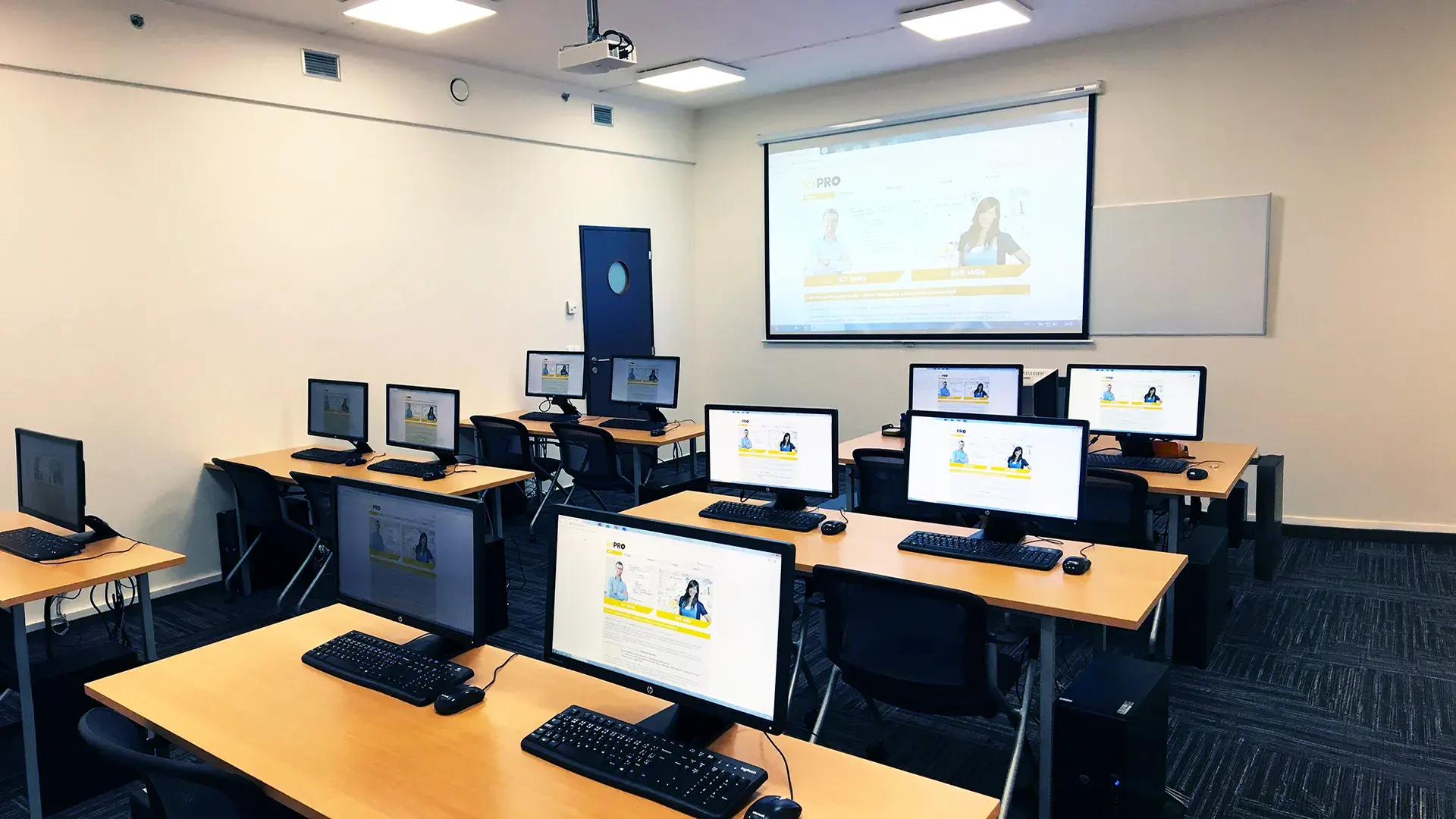 What does the environment for in-person IT courses look like?We hold training courses in our own classrooms equipped with modern computer equipment for each participant and a large projection screen. Each workstation is fitted with a powerful computer for seamless practical exercises, and the environment supports a calm, friendly atmosphere during training.
 Do I need to bring my own laptop to the classroom IT course?Our training rooms are fully equipped, so you do not need to bring your own laptop. A modern computer with all necessary hardware and software is ready for you at your workstation.
 Will you receive an official certificate after completing an IT course?Yes, upon successful completion of the training course, you will receive an official ICT Pro certificate confirming your participation and acquired technical skills. You can use it to verify your qualifications or add it to your professional profile.
 Where can you find our training center in Brno?The premises of the ICT Pro training center are located on the 1st floor of the COMGUARD building at Sochorova 38 in Brno. Positioned on the border of Žabovřesky and Komín, the location is easily accessible by both car and public transport.
 Where can you find our training center in Prague?The premises of the ICT Pro training center are located on the 1st floor of the Opatov Park building at Líbalova 1, Prague 11 – Chodov. The location provides a comfortable environment for your education with convenient access.
 What facilities and refreshments are available to you during training breaks?Our training centers feature a fully equipped kitchenette for a comfortable break during your courses. The facilities include a coffee machine, microwave, kettle, and a wide selection of drinks and snacks.
 What beverage refreshments are available during your course?A beverage station with a coffee machine, teas, syrups, and water is at your disposal throughout the entire training session. You can enjoy a coffee or another drink of your choice anytime during breaks.
 What light refreshments are provided for you during the courses?During course breaks, participants can enjoy light sweet snacks, pastries, and fruit syrups to mix their own drinks. Fresh water dispenser and plates are also available for your convenience.
 Should I bring my own snacks to ICT Pro training?There is no need to. A wide selection of savory snacks, sweet biscuits, and snack bars is available for you during breaks. Boost your energy for all-day focus right inside the training center premises.
 Can you spend training breaks in the fresh air?Yes, an outdoor terrace is available at our training center. During breaks between learning sessions, you can relax in the fresh air in a pleasant green environment.
 Where can you relax during course breaks?Our training center features a spacious outdoor terrace with seating options. During breaks between learning sessions, you can step outside to relax and recharge in the fresh air.