Artificial Intelligence for Legal Professionals and Insolvency Administrators (AILAW)
AI - Artificial Intelligence, AI for Professions
This three-day course explains practical use of modern AI tools in legal practice and insolvency administration, providing a comprehensive view of AI potentials and limits. Participants learn how LLMs analyse legal texts, structure documents and aid decisions.
It covers hands-on practice with prompt engineering, automation of routine tasks and AI-assisted drafting of filings and contracts. The course also covers integration strategies, pilot deployments, and security and ethics, including data protection and the EU AI Act.
THIS TRAINING COURSE WILL HELP YOU:
- Understand AI and LLMs in a legal context.
- Use main AI tools for legal documents and research.
- Write effective prompts for summaries, contracts and filings.
- Automate routine admin tasks and client correspondence.
- Design safe AI integration and governance for practice.
WHO SHOULD ATTEND?
- Lawyers, trainees and law firm staff.
- Insolvency administrators and their teams.
- In-house legal counsel and compliance officers.
- Anyone working with legal texts, research or institutions.
COURSE LOCATION AND AVAILABLE DATES
Need this course in English?
Public courses are usually delivered in Czech, but this course is also available in English. We can arrange private training for your team online, at your premises or in our classrooms, and tailor the content to your needs.
For groups of around 4 or more participants, private training can already be comparable in price to booking individual places on a public course. Send us your requirements and we’ll recommend the best format and provide an exact quote.
Request training in English
Course content:
Hide details
-
Basics of AI for legal practice
-
Motivation: why AI matters for lawyers today (case studies, numbers, trends)
-
Basics of AI, ML, NLP and large language models (LLMs) with legal focus
-
How AI "reads" text: tokens, embeddings and transformers
-
Overview of tools: ChatGPT, Copilot, Gemini and law-focused platforms
-
Prompt engineering: writing effective queries for summaries and opinions
-
Automation of administrative processes: document sorting, templates, records
-
Ethics and regulation: EU AI Act, GDPR and handling sensitive data
-
AI in legal processes and integration strategy
-
AI for research and analysis of case law
-
Automating communications with courts, debtors, banks, public bodies
-
Preparing filings and contracts with AI as an assistant
-
Creating and managing templates (e.g. insolvency notices, standard contracts)
-
Advanced prompting: Chain of Thought, reflection, self-critique, role prompting
-
Integrating AI into firm workflow: processes and team collaboration
-
AI strategy: quick wins versus long-term projects, roadmap and governance
-
AI security: risks, hallucinations, output validation and responsible use
-
Practical workshop: AI in action
-
Drafting and reviewing a contract with AI (workflow simulation)
-
Preparing a court filing step by step
-
Summarising a long file or decision into key points
-
Drafting correspondence with debtors or institutions using AI
-
Exercise: develop a participant’s own AI use-case from practice
-
Discussion: limits and best practices for deploying AI in legal work
-
Prerequisites:
-
No technical AI knowledge required; basic PC skills and familiarity with legal documents are enough.
-
Schedule:
-
3 days (9:00-17:00)
Training and learning environment
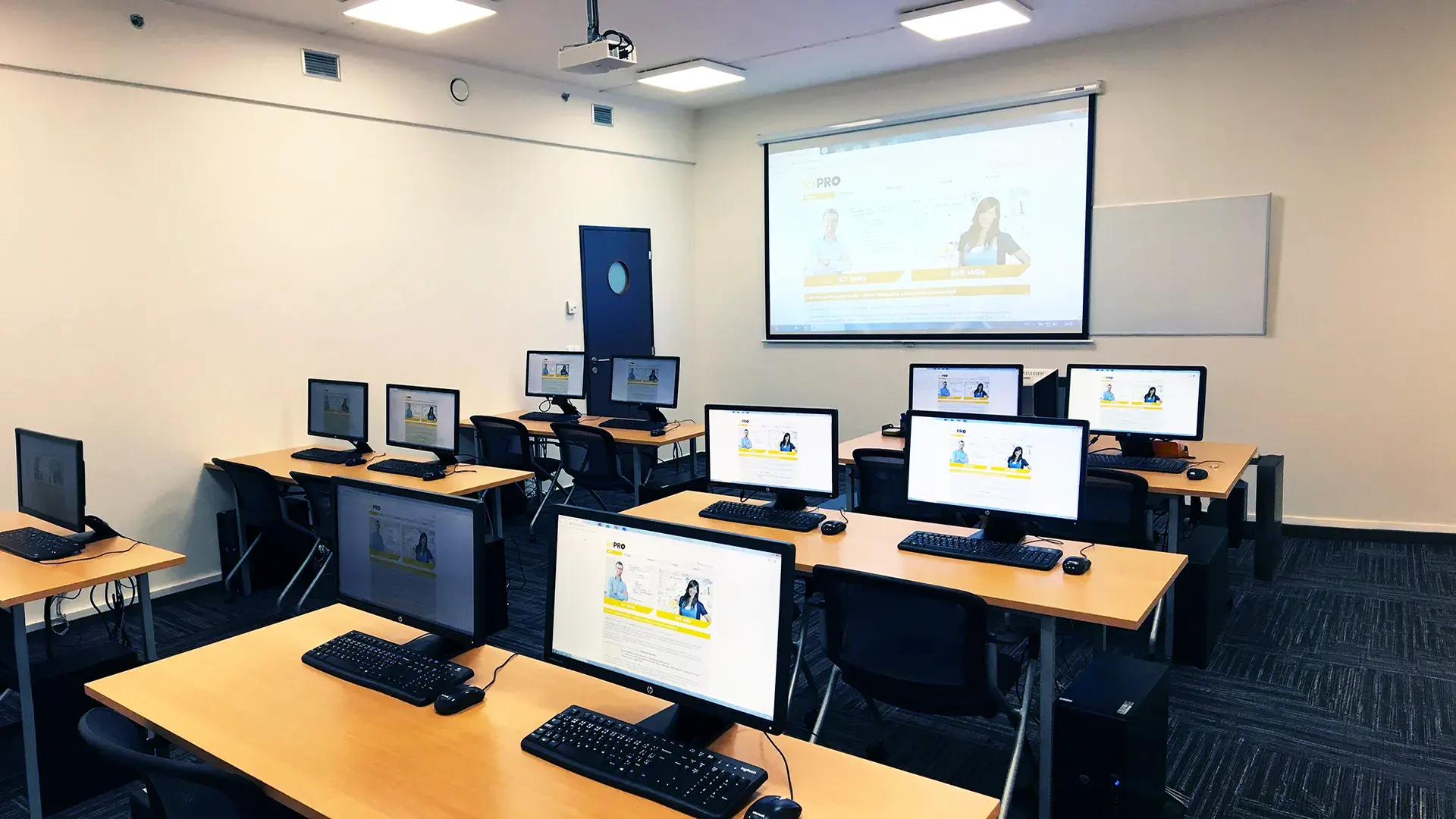 What does the environment for in-person IT courses look like?We hold training courses in our own classrooms equipped with modern computer equipment for each participant and a large projection screen. Each workstation is fitted with a powerful computer for seamless practical exercises, and the environment supports a calm, friendly atmosphere during training.
 Do I need to bring my own laptop to the classroom IT course?Our training rooms are fully equipped, so you do not need to bring your own laptop. A modern computer with all necessary hardware and software is ready for you at your workstation.
 Will you receive an official certificate after completing an IT course?Yes, upon successful completion of the training course, you will receive an official ICT Pro certificate confirming your participation and acquired technical skills. You can use it to verify your qualifications or add it to your professional profile.
 Where can you find our training center in Brno?The premises of the ICT Pro training center are located on the 1st floor of the COMGUARD building at Sochorova 38 in Brno. Positioned on the border of Žabovřesky and Komín, the location is easily accessible by both car and public transport.
 Where can you find our training center in Prague?The premises of the ICT Pro training center are located on the 1st floor of the Opatov Park building at Líbalova 1, Prague 11 – Chodov. The location provides a comfortable environment for your education with convenient access.
 What facilities and refreshments are available to you during training breaks?Our training centers feature a fully equipped kitchenette for a comfortable break during your courses. The facilities include a coffee machine, microwave, kettle, and a wide selection of drinks and snacks.
 What beverage refreshments are available during your course?A beverage station with a coffee machine, teas, syrups, and water is at your disposal throughout the entire training session. You can enjoy a coffee or another drink of your choice anytime during breaks.
 What light refreshments are provided for you during the courses?During course breaks, participants can enjoy light sweet snacks, pastries, and fruit syrups to mix their own drinks. Fresh water dispenser and plates are also available for your convenience.
 Should I bring my own snacks to ICT Pro training?There is no need to. A wide selection of savory snacks, sweet biscuits, and snack bars is available for you during breaks. Boost your energy for all-day focus right inside the training center premises.
 Can you spend training breaks in the fresh air?Yes, an outdoor terrace is available at our training center. During breaks between learning sessions, you can relax in the fresh air in a pleasant green environment.
 Where can you relax during course breaks?Our training center features a spacious outdoor terrace with seating options. During breaks between learning sessions, you can step outside to relax and recharge in the fresh air.