Introduction to Data Science (DM1)
Databases, NoSQL and Big Data
This course introduces the field of data science, showing what it covers from exploring data and creating visualizations to applying basic machine learning methods, and interpreting and evaluating results for practical use.
No programming skills are required; the hands-on part runs on a cloud platform (BigML) or on popular desktop tools like RapidMiner and Weka. The course covers data preparation, basic model evaluation, and a practical NLP example.
THIS TRAINING COURSE WILL HELP YOU:
- Understand core data science concepts and terminology
- Perform exploratory data analysis and create clear visualizations
- Prepare and clean data for modeling, including sampling
- Apply basic machine learning techniques and evaluate models
WHO SHOULD ATTEND?
- Business analysts and domain experts seeking data skills
- Professionals without a programming background
- Decision-makers who need to interpret data outputs
- Students preparing for roles in analytics or data science
COURSE LOCATION AND AVAILABLE DATES
Need this course in English?
Public courses are usually delivered in Czech, but this course is also available in English. We can arrange private training for your team online, at your premises or in our classrooms, and tailor the content to your needs.
For groups of around 4 or more participants, private training can already be comparable in price to booking individual places on a public course. Send us your requirements and we’ll recommend the best format and provide an exact quote.
Request training in English
Course content:
Hide details
-
Introduction and key concepts (data science vs. machine learning vs. artificial intelligence vs. data mining)
-
Typical workflow for analytical projects and stages of data analytics
-
Data, data types, and data quality
-
Exploratory data analysis and data visualization
-
Tools for data science and common choices
-
Local desktop tools (on a local computer)
-
R and Python languages (for Python, introduction to core libraries)
-
Cloud platforms
-
Data preparation
-
Selection
-
Data cleaning
-
Data transformation (value grouping, discretization, derived columns, …)
-
Sampling
-
Machine learning techniques
-
Linear regression
-
Classification tasks – logistic regression, decision trees, neural networks, Bayesian approaches
-
Clustering
-
Association rules
-
Anomaly detection
-
Interpreting results and model evaluation
-
Natural language processing with a practical example
-
State of the art in data science, machine learning, and artificial intelligence
-
Prerequisites:
-
Basic computer user skills and basic statistics.
-
Schedule:
-
2 days (9:00-17:00)
Training and learning environment
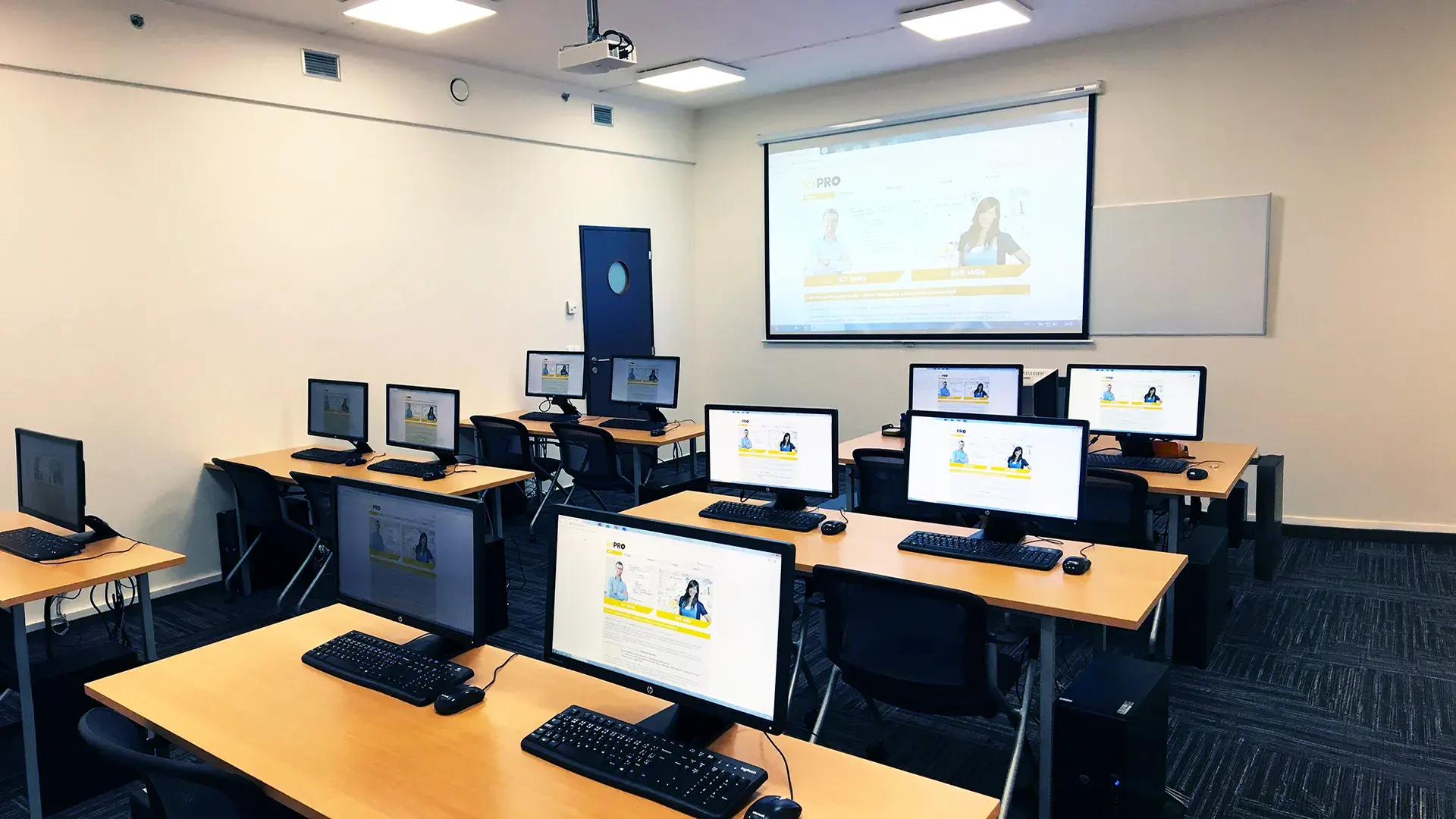 What does the environment for in-person IT courses look like?We hold training courses in our own classrooms equipped with modern computer equipment for each participant and a large projection screen. Each workstation is fitted with a powerful computer for seamless practical exercises, and the environment supports a calm, friendly atmosphere during training.
 Do I need to bring my own laptop to the classroom IT course?Our training rooms are fully equipped, so you do not need to bring your own laptop. A modern computer with all necessary hardware and software is ready for you at your workstation.
 Will you receive an official certificate after completing an IT course?Yes, upon successful completion of the training course, you will receive an official ICT Pro certificate confirming your participation and acquired technical skills. You can use it to verify your qualifications or add it to your professional profile.
 Where can you find our training center in Brno?The premises of the ICT Pro training center are located on the 1st floor of the COMGUARD building at Sochorova 38 in Brno. Positioned on the border of Žabovřesky and Komín, the location is easily accessible by both car and public transport.
 Where can you find our training center in Prague?The premises of the ICT Pro training center are located on the 1st floor of the Opatov Park building at Líbalova 1, Prague 11 – Chodov. The location provides a comfortable environment for your education with convenient access.
 What facilities and refreshments are available to you during training breaks?Our training centers feature a fully equipped kitchenette for a comfortable break during your courses. The facilities include a coffee machine, microwave, kettle, and a wide selection of drinks and snacks.
 What beverage refreshments are available during your course?A beverage station with a coffee machine, teas, syrups, and water is at your disposal throughout the entire training session. You can enjoy a coffee or another drink of your choice anytime during breaks.
 What light refreshments are provided for you during the courses?During course breaks, participants can enjoy light sweet snacks, pastries, and fruit syrups to mix their own drinks. Fresh water dispenser and plates are also available for your convenience.
 Should I bring my own snacks to ICT Pro training?There is no need to. A wide selection of savory snacks, sweet biscuits, and snack bars is available for you during breaks. Boost your energy for all-day focus right inside the training center premises.
 Can you spend training breaks in the fresh air?Yes, an outdoor terrace is available at our training center. During breaks between learning sessions, you can relax in the fresh air in a pleasant green environment.
 Where can you relax during course breaks?Our training center features a spacious outdoor terrace with seating options. During breaks between learning sessions, you can step outside to relax and recharge in the fresh air.