Windows Presentation Foundation – Application Development (WPF1)
Microsoft, Programming
Designed for developers, this course teaches building desktop apps with Windows Presentation Foundation. You’ll master core WPF concepts, practical use of Visual Studio, and development on the .NET Framework to deliver responsive modern user interfaces.
Through hands-on labs and examples you will implement Data Binding, build layouts and controls, apply Styling & Templates, and handle Commands. The course also covers Debugging, localization, 2D graphics, multimedia and deployment strategies.
THIS TRAINING COURSE WILL HELP YOU:
- Build WPF desktop applications using Visual Studio
- Design responsive UIs with layouts, controls and templates
- Implement data binding, validation and collection views
- Debug and test WPF applications and handle exceptions
- Localize apps, add graphics/multimedia and prepare deployment
WHO SHOULD ATTEND?
- C# developers building Windows desktop applications
- Developers migrating from Windows Forms to WPF
- UI designers creating styles, templates and animations
- Testers and maintainers responsible for WPF applications
COURSE LOCATION AND AVAILABLE DATES
Need this course in English?
Public courses are usually delivered in Czech, but this course is also available in English. We can arrange private training for your team online, at your premises or in our classrooms, and tailor the content to your needs.
For groups of around 4 or more participants, private training can already be comparable in price to booking individual places on a public course. Send us your requirements and we’ll recommend the best format and provide an exact quote.
Request training in English
Course content:
Hide details
-
Service-Oriented Architecture
-
Windows applications and WPF
-
Windows application architecture
-
Interoperability between Windows Forms and WPF
-
What's new in Visual Studio
-
What's new in WPF?
-
UI design and development
-
Creating page layouts
-
Using content controls
-
Using item controls
-
Sharing logical resources at the window level
-
Sharing logical resources at the application level
-
Creating a consistent UI with styles
-
Changing control appearance using templates
-
Event handling and the Commands infrastructure
-
Testing and debugging
-
WPF application testing strategies
-
Debugging XAML
-
Handling unhandled exceptions
-
Basics of security features
-
Basic data binding and validation
-
WPF data binding basics
-
Creating data bindings
-
Implementing property change notification
-
Data conversion
-
Data validation
-
Displaying data during development
-
Data binding to collections
-
Binding to a collection of objects
-
Using collection views
-
Creating master–detail UIs
-
Using data templates
-
Improving UI behavior
-
Implementing asynchronous processing
-
Implementing responsive UI
-
Localization and user assistance
-
Localization and globalization
-
Implementing user assistance features
-
Providing user accessibility features
-
WPF 2D graphics, multimedia and printing
-
2D graphics
-
Displaying images
-
Adding multimedia to a WPF application
-
Creating and printing documents
-
Creating custom controls
-
Fundamentals of creating WPF controls
-
Creating user controls
-
Creating custom controls
-
Controlling control appearance with visual states
-
Integrating WPF and Windows Forms
-
Module 12: Attached properties and behaviors in WPF
-
Implementing attached properties
-
Implementing drag-and-drop UI
-
Implementing Expression Blend behaviors, triggers and actions
-
Animations in WPF
-
Using animations
-
Using triggers
-
Implementing data visualizations
-
Application state and settings
-
Creating application settings
-
Using application settings
-
Creating custom configuration
-
Configuring and deploying WPF applications
-
Deployment options
-
Deploying a standalone WPF application
-
Deploying an XBAP application
-
Configuring security settings
-
Windows applications and WPF
-
Windows application architecture
-
Interoperability between Windows Forms and WPF
-
What's new in the current Visual Studio?
-
What's new in the current .NET Framework?
-
UI design and development
-
Creating page layouts
-
Using content controls
-
Using item controls
-
Sharing logical resources at the window level
-
Sharing logical resources at the application level
-
Creating a consistent UI with styles
-
Changing control appearance using templates
-
Event handling and the Commands infrastructure
-
Prerequisites:
-
Knowledge of C#; completion of the CNET1 course is recommended.
-
Recommended follow-up course:
-
Windows Presentation Foundation – WPF Databinding (WPF2)
-
Schedule:
-
3 days (9:00-17:00)
Training and learning environment
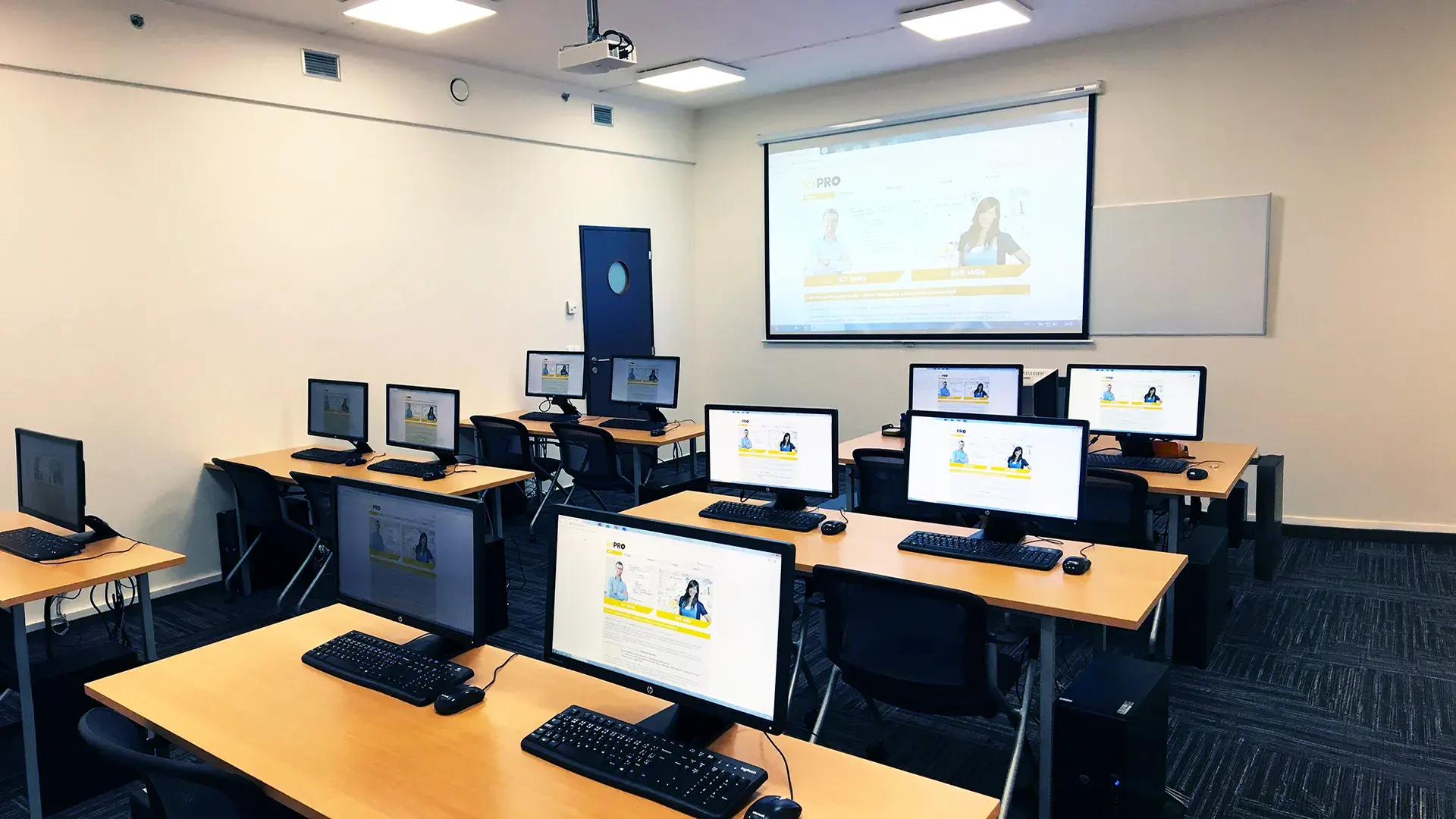 What does the environment for in-person IT courses look like?We hold training courses in our own classrooms equipped with modern computer equipment for each participant and a large projection screen. Each workstation is fitted with a powerful computer for seamless practical exercises, and the environment supports a calm, friendly atmosphere during training.
 Do I need to bring my own laptop to the classroom IT course?Our training rooms are fully equipped, so you do not need to bring your own laptop. A modern computer with all necessary hardware and software is ready for you at your workstation.
 Will you receive an official certificate after completing an IT course?Yes, upon successful completion of the training course, you will receive an official ICT Pro certificate confirming your participation and acquired technical skills. You can use it to verify your qualifications or add it to your professional profile.
 Where can you find our training center in Brno?The premises of the ICT Pro training center are located on the 1st floor of the COMGUARD building at Sochorova 38 in Brno. Positioned on the border of Žabovřesky and Komín, the location is easily accessible by both car and public transport.
 Where can you find our training center in Prague?The premises of the ICT Pro training center are located on the 1st floor of the Opatov Park building at Líbalova 1, Prague 11 – Chodov. The location provides a comfortable environment for your education with convenient access.
 What facilities and refreshments are available to you during training breaks?Our training centers feature a fully equipped kitchenette for a comfortable break during your courses. The facilities include a coffee machine, microwave, kettle, and a wide selection of drinks and snacks.
 What beverage refreshments are available during your course?A beverage station with a coffee machine, teas, syrups, and water is at your disposal throughout the entire training session. You can enjoy a coffee or another drink of your choice anytime during breaks.
 What light refreshments are provided for you during the courses?During course breaks, participants can enjoy light sweet snacks, pastries, and fruit syrups to mix their own drinks. Fresh water dispenser and plates are also available for your convenience.
 Should I bring my own snacks to ICT Pro training?There is no need to. A wide selection of savory snacks, sweet biscuits, and snack bars is available for you during breaks. Boost your energy for all-day focus right inside the training center premises.
 Can you spend training breaks in the fresh air?Yes, an outdoor terrace is available at our training center. During breaks between learning sessions, you can relax in the fresh air in a pleasant green environment.
 Where can you relax during course breaks?Our training center features a spacious outdoor terrace with seating options. During breaks between learning sessions, you can step outside to relax and recharge in the fresh air.