Basics of Networking in a Cisco Environment – CCNA Bootcamp (CCNA)
Networking, Cisco
This Cisco CCNA course is for entry-level network administrators and prepares you to design, deploy and operate a small enterprise network. It explains core LAN and WAN technologies, the TCP/IP model and addressing, and introduces switching and routing concepts.
The training includes hands-on labs in Cisco IOS and covers security, connectivity and management: ACLs and VPNs, deploying Wi‑Fi networks, and monitoring and maintenance. It also introduces automation and virtualization and maps to CCNA 200-301 objectives.
THIS TRAINING COURSE WILL HELP YOU:
- Design, install and operate small enterprise LAN/WAN networks
- Plan IPv4 and IPv6 addressing, CIDR and VLSM
- Configure and manage switches and routers (VLAN, routing)
- Implement security controls, NAT and VPN tunnels
- Deploy Wi-Fi and perform monitoring and maintenance
WHO SHOULD ATTEND?
- Entry-level network administrators and CCNA candidates
- IT specialists designing or managing LAN/WAN infrastructures
- Helpdesk staff and network engineers needing Cisco IOS skills
- Administrators focused on network security, ACLs and VPNs
- Engineers planning to use automation and virtualization
COURSE LOCATION AND AVAILABLE DATES
30 Nov–4 Dec 2026
916 €
CZECH
25–29 Jan 2027
916 €
CZECH
22–26 Mar 2027
916 €
CZECH
Praha + online (optional)
7–11 Dec 2026
916 €
CZECH
25–29 Jan 2027
916 €
CZECH
22–26 Mar 2027
916 €
CZECH
Need this course in English?
Public courses are usually delivered in Czech, but this course is also available in English. We can arrange private training for your team online, at your premises or in our classrooms, and tailor the content to your needs.
For groups of around 4 or more participants, private training can already be comparable in price to booking individual places on a public course. Send us your requirements and we’ll recommend the best format and provide an exact quote.
Request training in English
Course content:
Hide details
-
Introduction to TCP/IP networks
-
Basic networking concepts
-
Topologies for small and medium LANs
-
Basics of working with Cisco IOS
-
Comparison of OSI and TCP/IP models
-
Physical layer and data link in LANs
-
Ethernet addressing, standards and speeds
-
Introduction to the network layer
-
Transport layer: TCP and UDP
-
Application layer
-
Encapsulation analysis with Wireshark
-
Switching basics
-
Basic parameters, ports and PoE speeds
-
Principle of Ethernet frame switching
-
Switch MAC table (CAM)
-
Duplex and speed settings
-
IPv4 protocol
-
The IP protocol
-
IPv4 address structure, types and classes
-
Routers and their role
-
Routing table on a PC and a router
-
Role of ARP
-
Direct and indirect routing, default gateway
-
Types and sources of routing table entries
-
Commands: ping, tracert, arp, ipconfig, debug
-
Public vs private address space, NAT principle
-
Classful vs classless subnetting
-
CIDR and VLSM
-
Static and dynamic routing (OSPF single-area)
-
IPv6 protocol
-
Reasons to migrate to IPv6
-
IPv6 address structure, notation and address types
-
Key differences from IPv4 (ICMPv6, NDP)
-
IPv6 addressing methods (SLAAC, stateless/stateful DHCPv6)
-
Transition mechanisms (dual-stack, tunneling)
-
Static routing for IPv6
-
OSPFv3
-
NAT64
-
Building a small LAN with Internet access
-
Managing devices: console, Telnet and SSH
-
Basic configuration and hardening of switches and routers
-
Port-security
-
Access Control Lists (ACLs)
-
DHCP – assigning IP configuration to clients
-
Network Address Translation (NAT)
-
Virtual LANs (VLAN)
-
Access and trunk ports
-
Routing between VLANs (intra- vs inter-VLAN routing)
-
Dynamic Trunking Protocol (DTP)
-
Network redundancy
-
Campus LAN design
-
L2 redundancy – Spanning Tree Protocol (STP, RSTP, PVST+, Rapid PVST+)
-
STP features (portfast, BPDU guard, root guard)
-
Port aggregation (EtherChannel) – PAgP and LACP
-
Default gateway redundancy – HSRP, VRRP, GLBP
-
WAN networks
-
WAN network components
-
Overview of WAN standards
-
Technologies used in WANs
-
Maintenance, monitoring and troubleshooting
-
IOS maintenance (saving/backing up configs, password recovery)
-
Neighbor discovery (CDP and LLDP)
-
NTP, SNMP and remote logging (Syslog)
-
Network performance monitoring (ping, traceroute, show, debug)
-
Wireless
-
Wireless network types and Wi‑Fi standards
-
Standalone and controller-based architectures
-
CAPWAP tunnels
-
Wi‑Fi vulnerabilities and security
-
Best practices for Wi‑Fi deployment
-
Configuring home APs and WLC
-
Security
-
Introduction to cybersecurity
-
Common types of attacks
-
Cryptography basics
-
VPN concepts and IPsec
-
QoS (Quality of Service)
-
Metrics for measuring service quality
-
QoS models
-
Packet marking
-
Queueing mechanisms
-
Policing vs scheduling
-
Virtualization and automation
-
Cloud computing
-
Types of virtualization
-
Introduction to Cisco SDN concepts
-
Data formats (JSON, YAML, XML)
-
REST APIs
-
Configuration management (Ansible, Puppet, etc.)
-
Cisco DNA concept
-
Prerequisites:
-
Basic general knowledge of networking is recommended.
-
Recommended follow-up course:
-
Advanced Networking in Cisco Environments (CCNP)
-
Schedule:
-
5 days (9:00-17:00)
-
Price per person:
-
916.00 € (1 108.36 € incl. 21% VAT)
Training and learning environment
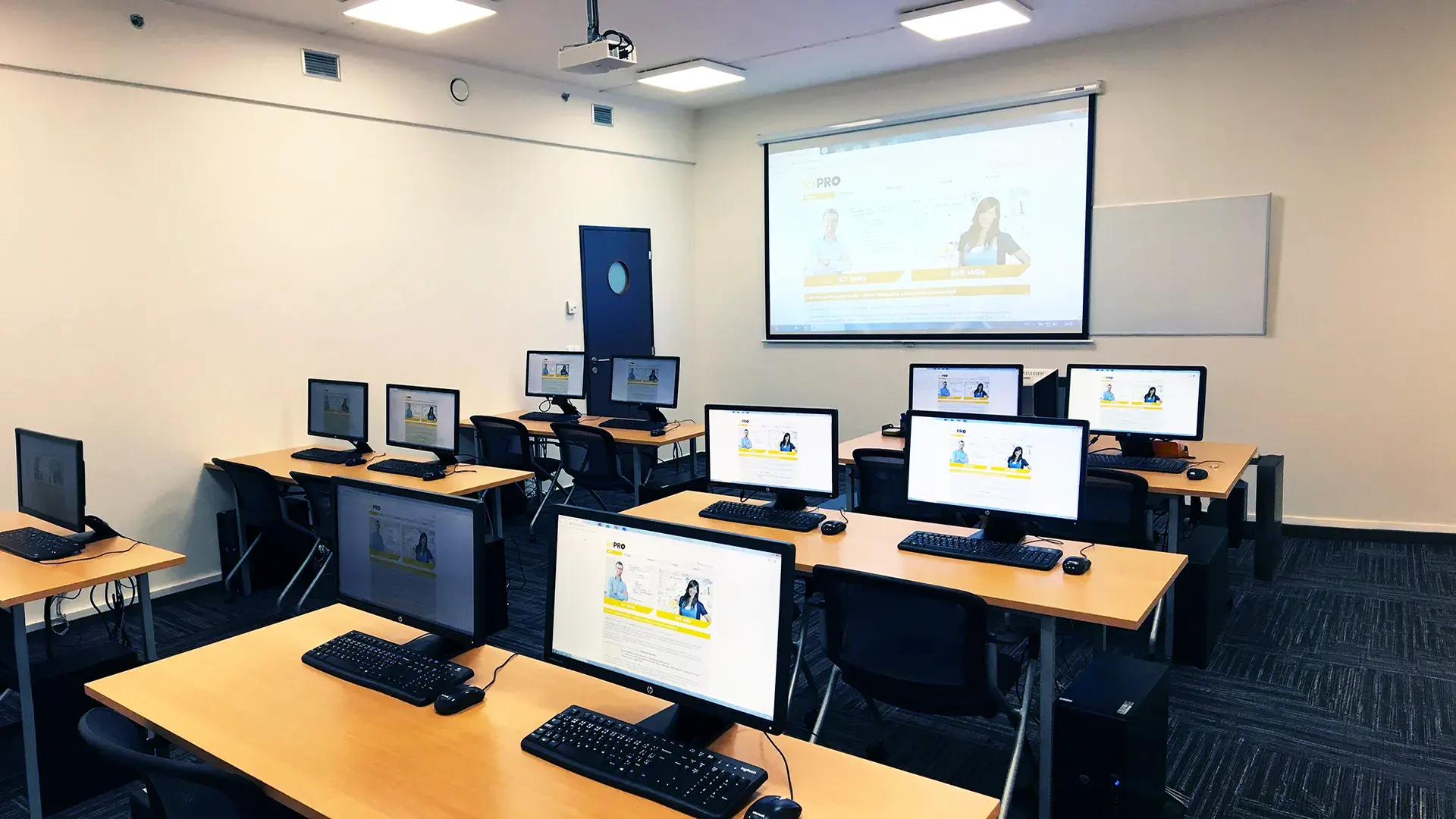 What does the environment for in-person IT courses look like?We hold training courses in our own classrooms equipped with modern computer equipment for each participant and a large projection screen. Each workstation is fitted with a powerful computer for seamless practical exercises, and the environment supports a calm, friendly atmosphere during training.
 Do I need to bring my own laptop to the classroom IT course?Our training rooms are fully equipped, so you do not need to bring your own laptop. A modern computer with all necessary hardware and software is ready for you at your workstation.
 Will you receive an official certificate after completing an IT course?Yes, upon successful completion of the training course, you will receive an official ICT Pro certificate confirming your participation and acquired technical skills. You can use it to verify your qualifications or add it to your professional profile.
 Where can you find our training center in Brno?The premises of the ICT Pro training center are located on the 1st floor of the COMGUARD building at Sochorova 38 in Brno. Positioned on the border of Žabovřesky and Komín, the location is easily accessible by both car and public transport.
 Where can you find our training center in Prague?The premises of the ICT Pro training center are located on the 1st floor of the Opatov Park building at Líbalova 1, Prague 11 – Chodov. The location provides a comfortable environment for your education with convenient access.
 What facilities and refreshments are available to you during training breaks?Our training centers feature a fully equipped kitchenette for a comfortable break during your courses. The facilities include a coffee machine, microwave, kettle, and a wide selection of drinks and snacks.
 What beverage refreshments are available during your course?A beverage station with a coffee machine, teas, syrups, and water is at your disposal throughout the entire training session. You can enjoy a coffee or another drink of your choice anytime during breaks.
 What light refreshments are provided for you during the courses?During course breaks, participants can enjoy light sweet snacks, pastries, and fruit syrups to mix their own drinks. Fresh water dispenser and plates are also available for your convenience.
 Should I bring my own snacks to ICT Pro training?There is no need to. A wide selection of savory snacks, sweet biscuits, and snack bars is available for you during breaks. Boost your energy for all-day focus right inside the training center premises.
 Can you spend training breaks in the fresh air?Yes, an outdoor terrace is available at our training center. During breaks between learning sessions, you can relax in the fresh air in a pleasant green environment.
 Where can you relax during course breaks?Our training center features a spacious outdoor terrace with seating options. During breaks between learning sessions, you can step outside to relax and recharge in the fresh air.