Advanced JavaScript and Introduction to Node.js (JVS2)
Programming, JavaScript
In this course you deepen core JavaScript skills and learn modern techniques such as Web APIs, BigInt and internationalization. You will explore OOP in JavaScript: prototypes, inheritance, ES6 classes, closures, getters and setters, and prototype extensions.
Next you move to server-side JavaScript with Node.js, covering file system access, modules, npm packaging and building a basic HTTP server for GET and POST. You will learn regular expressions, client storage (cookies, localStorage) and web security, plus Babel and Webpack.
THIS TRAINING COURSE WILL HELP YOU:
- Deepen modern Web APIs skills (WebSockets, Geolocation, BigInt)
- Use JavaScript OOP: prototypes, ES6 classes, closures, getters/setters
- Design modular code with import/export and manage npm dependencies
- Use RegExp for validation and handle client storage (cookies, localStorage)
- Build Node.js servers, use file system and apply security measures
WHO SHOULD ATTEND?
- Developers with intermediate JavaScript aiming for advanced level
- Frontend devs who want to add server-side Node.js skills
- Programmers aiming for clean, modular and secure JavaScript code
- Developers who need input validation and client-side storage skills
- Those wanting to use tools like Babel, Webpack and npm
COURSE LOCATION AND AVAILABLE DATES
25–27 Nov 2026
576 €
CZECH
20–22 Jan 2027
576 €
CZECH
17–19 Mar 2027
576 €
CZECH
Praha + online (optional)
15–17 Feb 2027
576 €
CZECH
12–14 Apr 2027
576 €
CZECH
Need this course in English?
Public courses are usually delivered in Czech, but this course is also available in English. We can arrange private training for your team online, at your premises or in our classrooms, and tailor the content to your needs.
For groups of around 4 or more participants, private training can already be comparable in price to booking individual places on a public course. Send us your requirements and we’ll recommend the best format and provide an exact quote.
Request training in English
Course content:
Hide details
-
Debugging
-
Developer tools
-
Commands for stepping through and inspecting code
-
New and advanced JS data types and features
-
ES6+ variable declarations
-
Template literals, numeric literal separators
-
Nullish coalescing, optional chaining, numeric separators
-
Extending core prototypes, polyfills
-
Objects, spread and destructuring
-
Iterators: Array, Map and Set
-
Negative array indexes
-
Functions: changing context with apply and call, bind
-
Arrow functions
-
Promises and async functions
-
Top-level await and global this
-
Cloning objects, hasOwn
-
JavaScript versions in browsers, MDN
-
Modern browser APIs
-
Workers
-
Internationalization
-
WebSockets
-
Custom elements
-
Clipboard
-
Geolocation
-
Notifications
-
Big numbers: BigInt
-
OOP in JavaScript
-
Prototyping – static and dynamic properties and methods
-
Prototyping – creating inheritance
-
Calling parent methods and passing context
-
Closures
-
The ES6 class statement
-
Private and static properties and methods
-
Getters and setters
-
Node.js
-
Focus and advantages of using Node.js
-
Development workflow and debugging
-
File system and core modules
-
Packaging systems and libraries
-
Creating a Node.js server and handling data (POST, GET)
-
Modules
-
Core principles of modules
-
import, export, default export and import
-
Modular files
-
import.meta
-
Regular expressions
-
What regular expressions are and their uses
-
Syntax and creating a regular expression
-
Literals, special characters, modifiers and quantifiers
-
Character classes and sets
-
Backreferences
-
Using test, exec, replace and split
-
Validation before submitting forms
-
Client-side data storage
-
Cookies
-
Local Storage
-
Security
-
Securing cookies
-
CSRF attacks
-
XSS attacks
-
Protecting application user input
-
Theft of admin cookies
-
Building universal applications for main browsers
-
Polyfills
-
Using Node.js in web app development (Babel, Less, uglify, Webpack)
-
Prerequisites:
-
Requires Windows or Mac, abstract thinking, and prior HTML, CSS and beginner JavaScript knowledge or equivalent experience.
-
Recommended previous course:
-
JavaScript for Beginners (JVS1)
-
Recommended follow-up course:
-
TypeScript (TS1)
-
Schedule:
-
3 days (9:00-17:00)
-
Price per person:
-
576.00 € ( 696.96 € incl. 21% VAT)
Training and learning environment
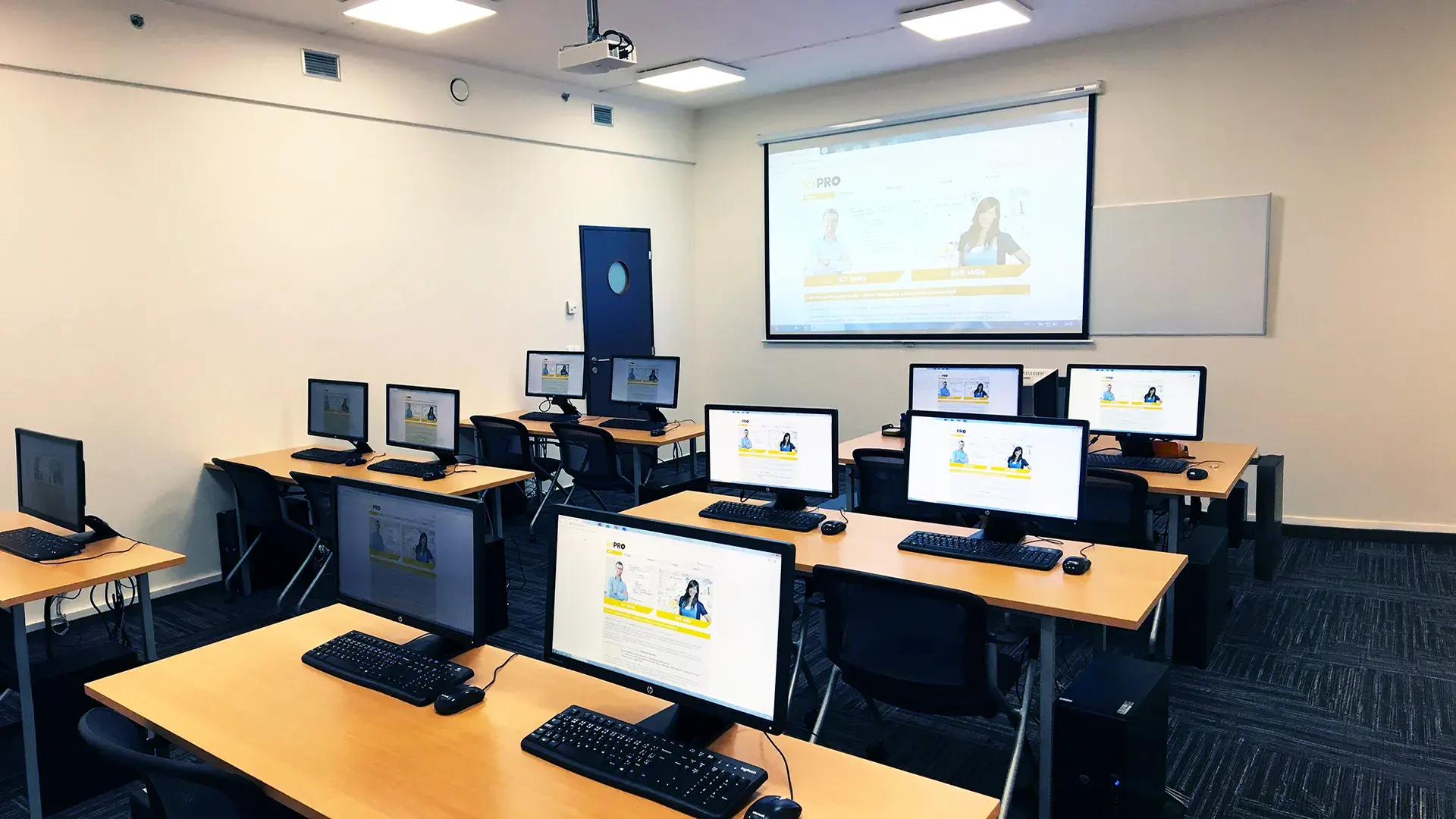 What does the environment for in-person IT courses look like?We hold training courses in our own classrooms equipped with modern computer equipment for each participant and a large projection screen. Each workstation is fitted with a powerful computer for seamless practical exercises, and the environment supports a calm, friendly atmosphere during training.
 Do I need to bring my own laptop to the classroom IT course?Our training rooms are fully equipped, so you do not need to bring your own laptop. A modern computer with all necessary hardware and software is ready for you at your workstation.
 Will you receive an official certificate after completing an IT course?Yes, upon successful completion of the training course, you will receive an official ICT Pro certificate confirming your participation and acquired technical skills. You can use it to verify your qualifications or add it to your professional profile.
 Where can you find our training center in Brno?The premises of the ICT Pro training center are located on the 1st floor of the COMGUARD building at Sochorova 38 in Brno. Positioned on the border of Žabovřesky and Komín, the location is easily accessible by both car and public transport.
 Where can you find our training center in Prague?The premises of the ICT Pro training center are located on the 1st floor of the Opatov Park building at Líbalova 1, Prague 11 – Chodov. The location provides a comfortable environment for your education with convenient access.
 What facilities and refreshments are available to you during training breaks?Our training centers feature a fully equipped kitchenette for a comfortable break during your courses. The facilities include a coffee machine, microwave, kettle, and a wide selection of drinks and snacks.
 What beverage refreshments are available during your course?A beverage station with a coffee machine, teas, syrups, and water is at your disposal throughout the entire training session. You can enjoy a coffee or another drink of your choice anytime during breaks.
 What light refreshments are provided for you during the courses?During course breaks, participants can enjoy light sweet snacks, pastries, and fruit syrups to mix their own drinks. Fresh water dispenser and plates are also available for your convenience.
 Should I bring my own snacks to ICT Pro training?There is no need to. A wide selection of savory snacks, sweet biscuits, and snack bars is available for you during breaks. Boost your energy for all-day focus right inside the training center premises.
 Can you spend training breaks in the fresh air?Yes, an outdoor terrace is available at our training center. During breaks between learning sessions, you can relax in the fresh air in a pleasant green environment.
 Where can you relax during course breaks?Our training center features a spacious outdoor terrace with seating options. During breaks between learning sessions, you can step outside to relax and recharge in the fresh air.